Showing posts with label Financial Crisis. Show all posts

Wednesday, February 3, 2010

The Ghost of Fed Chairmen Past


Via TBP:

When challenging the former Fed Chair about the Volcker Rule, Sen. Mike Johanns (R., Neb.) learned why Tall Paul is not a man to be trifled with.

The Senator accused Volcker and the White House of trying to add onto an already confusing proposal. Volcker’s response was utterly classic:

>

“I tell you sure as I am sitting here, that if banking institutions are protected by the taxpayer and they are given free reign to speculate, I may not live long enough to see the crisis, but my soul is going to come back and haunt you.”

Monday, December 14, 2009

The Crisis of Credit Visualized

Very well done animation on the credit crisis:

The Crisis of Credit Visualized from Jonathan Jarvis on Vimeo.


via Planet Money

Sunday, December 13, 2009

Back-asswards: Biggifying Too Big to Fail

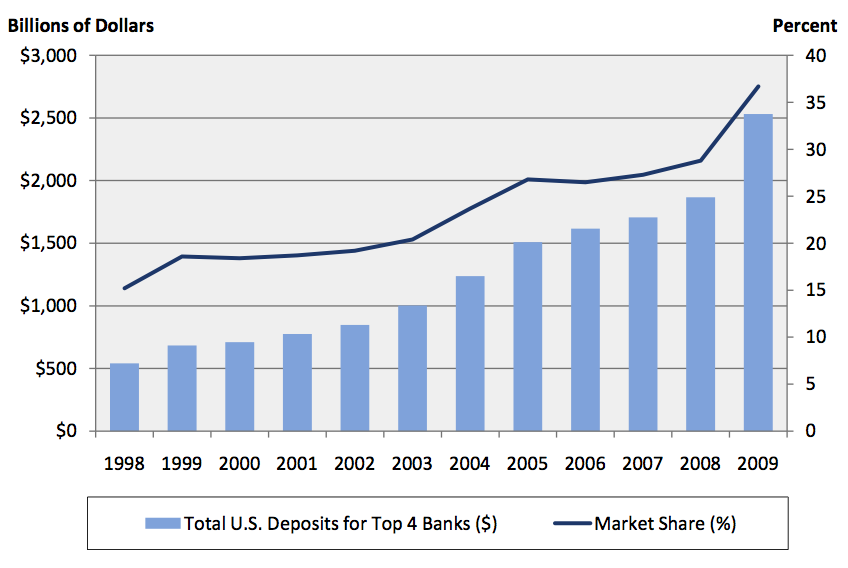
What do we do in response to a financial crisis due in no small part to the systemic risk posed by institutions that by their very size prove essential to a functioning financial system? Gorge them on taxpayer funds so they get even bigger, while smaller banks without the benefit of implicit government guarantee are allowed to fail (as all insolvent businesses should):


From TARP Oversight Report via TBP.

Monday, November 9, 2009

Friday, July 24, 2009

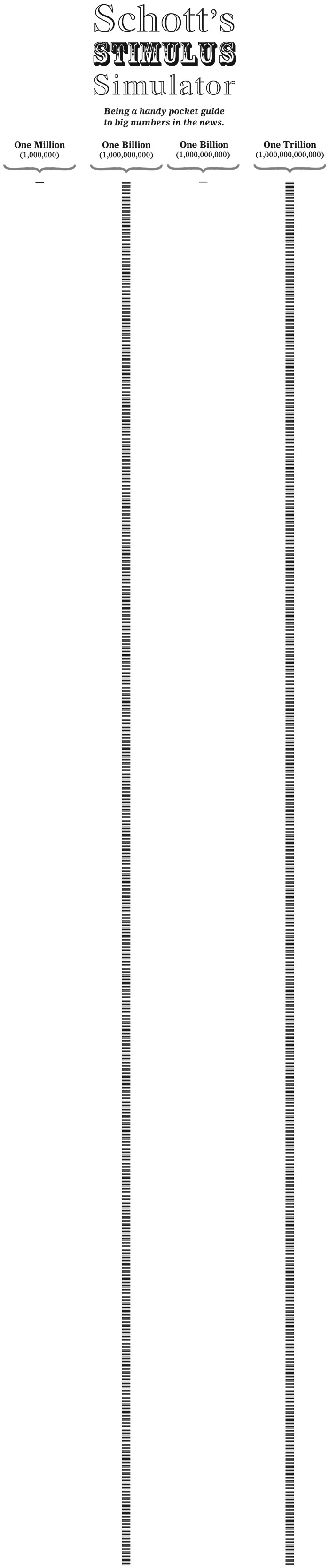
Trillion Is the New Billion

Great video illustrating how much 1 trillion bones, or clams, or whatever you call them, is:


Via The Big Picture.

Wednesday, June 10, 2009

Hasn't This Guy Ever Heard of the Deflationary Death Spiral?

Not sure how, but I get these occasional newsletters from CaseyResearch.com, and this recent one was rather contrarian to say the least. Casey not only says that deflation is a good thing, but he absolutely rips into my beloved Economist (not to mention all those Nobel laureates out there). That got my ire up but I wanted to see what he had to say:

Q: Doug, according to a recent article called "The Greater of Two Evils," The Economist recently stated that inflation is preferable to deflation. What is your take on that?

Doug Casey: It was certainly one of the most ridiculous articles that I have read in recent years. It is disappointing that The Economist is employing the same quality analysts that have populated magazines like Slime and Newspeak for so long -- utterly conventional, thoughtless, and statist in outlook. Everything in this article is not only wrong but the opposite, exactly the opposite of what the truth is.

You know, it is funny. It starts off with a section title saying "Inflation Is Bad, But Deflation Is Worse." No, inflation is very bad, and deflation is actually quite a good thing. I will explain that in a moment. But the first thing that drew my attention in the ridiculous article was a laudatory comment about Paul Krugman, who, they point out, is a Nobel laureate in economics.

My first comment is that the granting of a Nobel Prize in economics is as meaningless and arbitrary as the granting of the Nobel Peace Prize, which is really just a prize in political correctness and whatever appeals to the mob at the moment. These things are all very arbitrary. They have had excellent economists, and they have had anti-economists nominated for the Nobel Prize in Economics. It’s as meaningless an award as the Peace Prize -- which has been given to criminal personalities like Kissinger and Arafat, and buffoons like Al Gore.

[...]

Deflation is actually a good thing, because in a deflation prices drop and money becomes more valuable, so deflation encourages people to save money. Deflation rewards the prudent saver and punishes the profligate borrower. The way a society, like an individual, becomes wealthy is by producing more than it consumes. In other words, by saving, not borrowing. And during a deflation, when money becomes more valuable, everybody wants money. They want to save. Whereas during an inflation, you want to get rid of the money. You want to consume. You want to spend. But you don’t become wealthy by spending and consuming; you become wealthy by producing and saving.

Inflation encourages people to borrow, because they expect to pay the debt off with cheaper dollars. It encourages people to mortgage their future.

Fiery! I enjoy reading contrarian stuff, although Casey comes across as unnecessarily nasty (looks like that's his schtick, now that I check the site a bit). I don't like having to sift good ideas out of irrelevant invective. I think he does hit on a couple good points - 6-12 mos. of low deflation is probably not a bad thing with regard to increasing personal savings rates, encouraging consumer deleveraging, etc. And it certainly makes the current climate of laughable bank savings and CD interest rates more tolerable. But that's not a sustainable situation. Casey doesn't address the inherent problems of the deflationary death spiral (I love that phrase - sounds like some sort of evil econ prof's terror weapon). He also hints at being one of these guys who wants to return to the gold standard and probably has a custom-made vault in his basement to hold his hoard of bullion. The majority of stuff I've read (admittedly a tiny amount) holds that low to moderate inflation is a good thing.

Then again, I slept through Econ 1, so what do I know?

(Also, Mr Casey, the journalists at The Economist make you look like an arrogant windbag.)

Tuesday, June 9, 2009

TARP ROI? Also: PPIP, we hardly knew ye.

A tasty morsel from Planet Money:

Treasury Department just sent out this statement saying that 10 of the largest financial institutions have been cleared to repay their bailout money, totaling as much as $68 billion.
Mixed news of course - we'll have to wait until all is said and done to properly judge TARP, and this ignores any systemic or solvency problems that may still exist, but if the taxpayer comes close to breaking even on this it'll be a major win.


On a related note, remember all the hullabaloo about Geithner's infamous PPIP? Yeah, that whole thing never got off the ground. (Which might actually be a good thing.)

Thursday, June 4, 2009

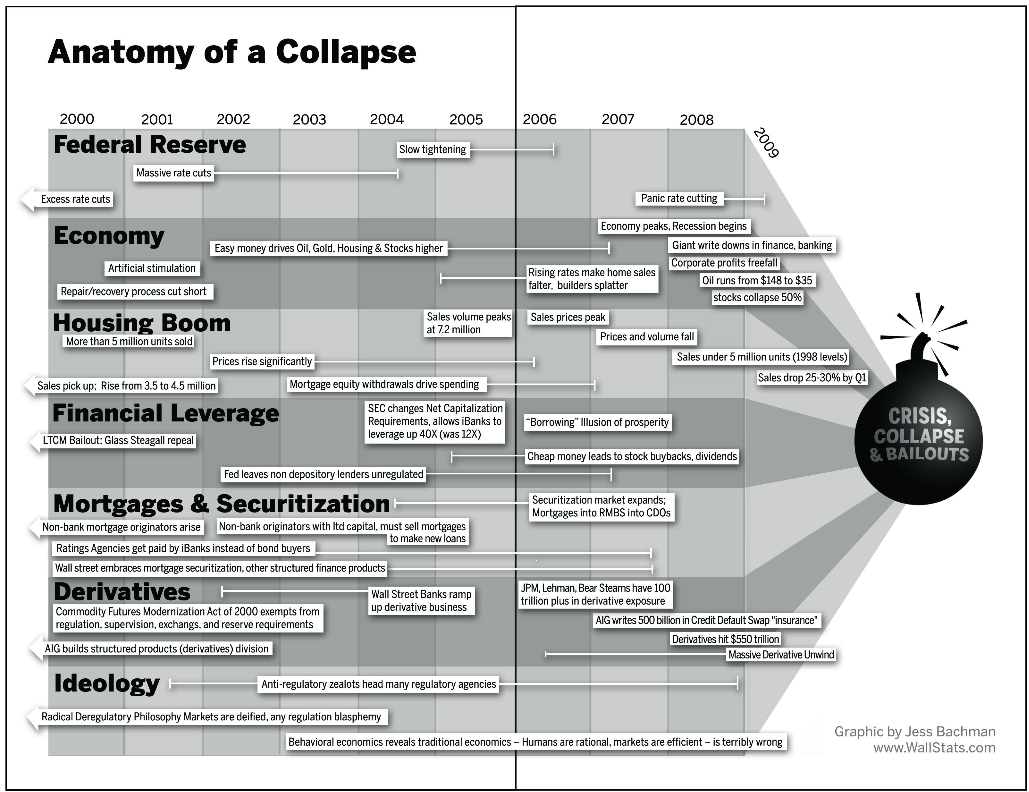
Anatomy of a Collapse

An excellent infographic detailing the causes of the Great Financial Meltdown of 2008-? From The Big Picture, lifted from Ritholz's new book, Bailout Nation.


(Click to enlarge.)

I would've preferred they had used an image of a gigantic shit sandwich instead of a bomb at the end.

Wednesday, May 20, 2009

Fixing a Broken State

There's an excellent article in the latest Economist about the possibility of California holding a constitutional convention sometime in the next few years to rewrite their current mammoth guiding document (it's longer than the U.S. Constitution). Strict rules for tax and budget legislation; gerrymandering; posturing extremists in the legislature on both sides; overreaching direct diplomacy with numerous wacky referenda in recent decades; all coming to a head in the current financial crisis with California's finances shot - huge budget deficits looming amidst plummeting tax receipts and a bond rating that counts for dead last of the 50 states.

It'll be interesting to see how this plays out. I like the idea of selecting convention members from the jury pool - how much more democratic can you get? (Although I wonder if there will be as many excuses to get out of convention duty...)

Saturday, April 11, 2009

Is This Rally for Reals?

Probably not. But what do I know?

For more authoritative opinions, check out this roundtable over at NYT between Simon Johnson, Nicholas Bloom, and Barry Ritholz about the market's rally since its March 9th low. Johnson's all doom and gloom; Bloom's a bit more measured in his take on the situation; Ritholz offers investment strategy more than analysis of the virtues of this recent rally.

(Although Ritholz seems to offer somewhat contradictory advice. If buy and hold is a "losing strategy" in a bear market, then why does he say "For many investors, dollar cost averaging into broad index funds works well" and then actually suggest that they increase their investments during major downturns like the present? "If you want to be a bit aggressive, you can increase your contributions once the markets fall 30 percent or (like now) 50 percent." I think the key here is the difference between active traders and passive buy-and-hold investors - active strategy will change depending on the market situation; for most average investors, passive dollar cost averaging is the way to go regardless of market conditions. And indeed in the case of the latter, increasing that investment during major downturns is a way to pick up extra shares on the cheap.)

Thursday, April 9, 2009

One from "The More Things Change..." File:

A cartoon from the Chicago Tribune, 1934. The refrain sounds so familiar, doesn't it? (Click to enlarge.)


Via the increasingly indispensable Big Picture.

Wednesday, April 8, 2009

Perhaps an iShares PPIP ETF? (pt. II)

Looks like Treasury is now entertaining the possibility of letting big investment firms create "bailout bonds" (think war bonds) in mutual funds which would allow the average investor to participate in the PPIP, as I previously mentioned. I think this is a great idea in its own right; whether or not the PPIP will work as Geithner envisions remains to be seen.

But if you want to invest in something you're subsidizing anyway it's worth a look.

Monday, April 6, 2009

Heads Will May Roll!

"The very notion that anyone would infuse money into a financially troubled entity without demanding changes in management is preposterous."

-Elizabeth Warren, Chair of the Congressional Oversight Panel to oversee the TARP
I agree, Lizzie. But guess what? We already did! What now?

Elizabeth Warren, chief watchdog of America's $700bn (£472bn) bank bailout plan, will this week call for the removal of top executives from Citigroup, AIG and other institutions that have received government funds in a damning report that will question the administration's approach to saving the financial system from collapse.

Warren, a Harvard law professor and chair of the congressional oversight committee monitoring the government's Troubled Asset Relief Program (Tarp), is also set to call for shareholders in those institutions to be "wiped out". "It is crucial for these things to happen," she said. "Japan tried to avoid them and just offered subsidy with little or no consequences for management or equity investors, and this is why Japan suffered a lost decade." She declined to give more detail but confirmed that she would refer to insurance group AIG, which has received $173bn in bailout money, and banking giant Citigroup, which has had $45bn in funds and more than $316bn of loan guarantees.

It'll be interesting to see how this plays out. Is the Panel then recommending FDIC receivership? How does Warren see the shareholders getting wiped out? All common stock goes to Uncle Sam?

And who has the authority to act or not on the Panel's recs? Treasury? Can Geithner just give Warren the Heisman on this or is the ball in Congress's court now?

Clearly this has been a case of putting the (gold-plated) cart before the proverbial horse.

Via capitalism, birthday suit style.

Sunday, April 5, 2009

The Numbers: It's All Relative


NYT by way of TBP.

Friday, April 3, 2009

Snapshot of the Economy: A Thumbnail

I find it fascinating to see how the economy affects everyday things that one might not otherwise give a second thought to. I thought this was a neat snippet:

Beerzie Boy writes from Sacramento:

We have a soda machine at work that, like most soda machines, can be persnickety about taking bills when they are wrinkled. You have to smooth the bill and unfold the corners perfectly to get the bill to go into the machine. Last year about this time, I could not get the machine to take a dollar bill, no matter how flat and perfect it was, so I would always have to use change to get a soda. It was a real pain, because I often didn't have change and would have to pester my co-workers to get some. One day when I saw the vending machine guy filling the machine, I asked him why this was happening. He told me that when the machine gets full of bills, it refuses to take any more. Pretty simple.

Recently, the opposite started to happen: I would try to use change, and it would refuse to take it and dump it in the coin return. At first it only refused quarters, then it started to refuse dimes, then nickels. Now it will only take bills. When I saw the vending machine guy he said -- you have probably guessed it -- that the coin bins were filling faster than the bill bin. He also said this was becoming more common on the machines on his route. So I guess that people are digging deeper into their purses, piggy banks, and car ashtrays for the money to get their daily soda fix, and saving their bills for more important things.
Via Planet Money.

Thursday, April 2, 2009

FASB's Ruling: Does That Seem Right to You?

My initial take on the Financial Accounting Standards Board's ruling is that it's wrongheaded, allowing banks not to have to mark their assets down to market prices (the plummeting values of written-down toxic assets having caused the current banking solvency crisis):

Today the Financial Accounting Standards Board voted to let banks and other companies change the way they value assets. The idea is to give them a break from mark-to-market accounting, which requires them to price the assets at whatever they could sell them for now.

Lately, those prices haven't been so high. But what about when times are terrific, and the market value of assets is implausibly great?

"As it stands, the new accounting rules only work when the market is inactive, like we are witnessing at the moment," says Joshua Ronen, an accounting professor at New York University. "When a market is irrationally exuberant the market is seen as active, so this would not apply."

This means that banks can reap the benefits of high prices in a hot market, and limit their losses when the market dries up. Ronen calls this double standard the "idiocy of this guidance."

("Banks Get the Best of It" at Planet Money)

But then again, it could really help with the solvency problem:
Although it seems clear that the political pressure brought to bear on FASB helped expedite the decision, this seemed to be the direction that they were moving. Cynics will claim this is a thinly veiled attempt to disguise the seriousness of the financial crisis and losses being faced. On the other hand, there are many who see the mark-to-market as an unreasonable demand for financial instruments with no markets. Regardless though of the merits or de-merits, the net impact could help boost bank earnings, reduce the need for capital injections and may help encourage participation in P-PIP [Public-Private Investment Programs] and TALF [Term Asset-Backed-Securities Loan Facility] programs.

(Marc Chandler of Brown Brothers Harriman via Planet Money)
It'll be interesting to see how this works alongside Geithner's PPIP. Thoughts?

Monday, March 30, 2009

Hungary for Recovery

Because of my trip to Budapest last year, I've felt an odd connection to Hungary as I've read increasingly bad news coming out of Central Europe these days.

A weakening currency; contracting economy; the Prime Minister having recently stepped down after a vote of no confidence; and today Standard & Poors cut the Hungarian government bond rating to just above junk.

Tough times for a Magyar.

A Stupefying Amount of Cabbage

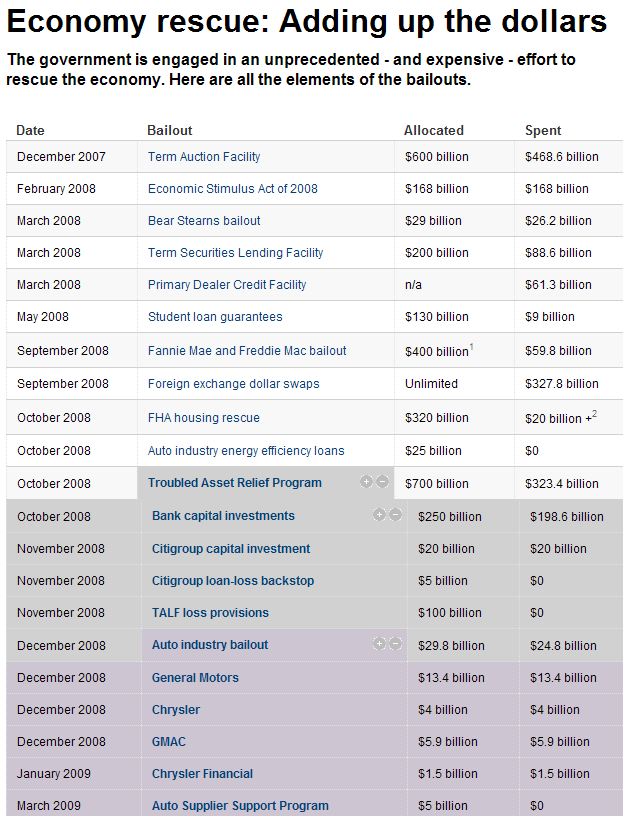
Check out this interactive chart over at CNNMoney.com. It shows the total amount of money involved in the economic rescue itemized by program:


$2.6 trillion - and that's only a quarter of the total allocated!

Can a brother hold a couple big dimes?

Via Ritholz.

Digging Deeper on Geithner's Plan

I've been watching several excellent videos explaining the Geithner Public-Private Investment Partnership (PPIP) plan over at the YouTubes courtesy of Salman Khan of the Khan Academy. Khan explains things clearly and effectively with simple visual aids.

If you're confused about the plan (and confusing it is) then check out Khan's series. He starts off explaining the basics of how the plan works and then in "Geithner II" raises the disturbing point that these banks could buy these assets from themselves - via special investment vehicles, hedge funds, or other independent entities associated with the banks - in effect recapitalizing themselves by shoring up balance sheets with a fat government subsidy:


This does seem like an almost foregone conclusion unless the gov't can somehow prevent it through legal means...but I'm not sure they can. Even if the banks do an end-around here, it might actually work in terms of recapitalizing the banks and avoiding insolvency, but it would essentially be an indirect bailout, which is extremely distasteful right now. I'm more or less in agreement with Khan and the Krugman/Johnson camp - the sooner we nationalize these institutions ("nationalize" in the sense of putting them into FDIC receivership, recapitalization, and eventual reprivatization) - the sooner we can rebound from this crisis. Even if the PPIP works to keep the banks functioning, it does so at great expense to the taxpayer and does nothing to address the systemic risk of these "too big to fail" banks. I'd prefer the definite path of nationalization rather than this pseudo-nationalization by way of enormous gov't subsidy.

In his latest video, "Geithner 5: A better solution," Khan addresses the problem which the PPIP is intended to solve - that of a lack of information about these toxic assets and liquidity (ignoring for the moment the high likelihood that it's as much as or even more of a solvency problem than a liquidity one). He has a great idea, similar to the one I mentioned here, to open up the market to all investors and provide detailed information on all these toxic assets. Basically list these assets as shares of corporations (owned by their respective banks) on the New York Stock Exchange and allow anyone to purchase shares. At the moment these assets are only available to institutional or large net worth investors via hedge funds and the like; mincing them into thousands of shares would allow access to Phil Everyman. Aside from the idea that individual investors should be able to receive the benefits of the "Geithner put" just like hedge funds, Khan's idea solves both the lack of information and liquidity problems:


There are details to be worked out in the execution, of course. The analysis and summaries of the assets as he describes would take some time and a lot of hard work on the part of some smart people, but it's something that, once done, would allow any individual with a modicum of means to invest in these assets.

I find this stuff fascinating, intimidating, and troubling all at once.

Friday, March 27, 2009

A Silver Lining?

One of the possible upsides of this crisis is that we might once again have a reasonable national savings rate. As recently as three years ago we were, as a country, spending more than 100% of our income. The ensuing credit bubble, fed in no small part by ballooning home prices, was a big factor in EconoShitstorm '08. Check out the graph below for perspective on historical personal savings rates:


Sometimes an existential crisis is required for us to make fundamental changes as a society.

Via Planet Money.