The Crisis of Credit Visualized
Very well done animation on the credit crisis:
The Crisis of Credit Visualized from Jonathan Jarvis on Vimeo.
via Planet Money
Very well done animation on the credit crisis:
The Crisis of Credit Visualized from Jonathan Jarvis on Vimeo.
 Reading this article will make you furious. In a recent article for Rolling Stone , titled "Obama's Big Sellout," Matt Taibbi eviscerates the Obama White House, saying that President Obama has . . . more
What do we do in response to a financial crisis due in no small part to the systemic risk posed by institutions that by their very size prove essential to a functioning financial system? Gorge them on taxpayer funds so they get even bigger, while smaller banks without the benefit of implicit government guarantee are allowed to fail (as all insolvent businesses should):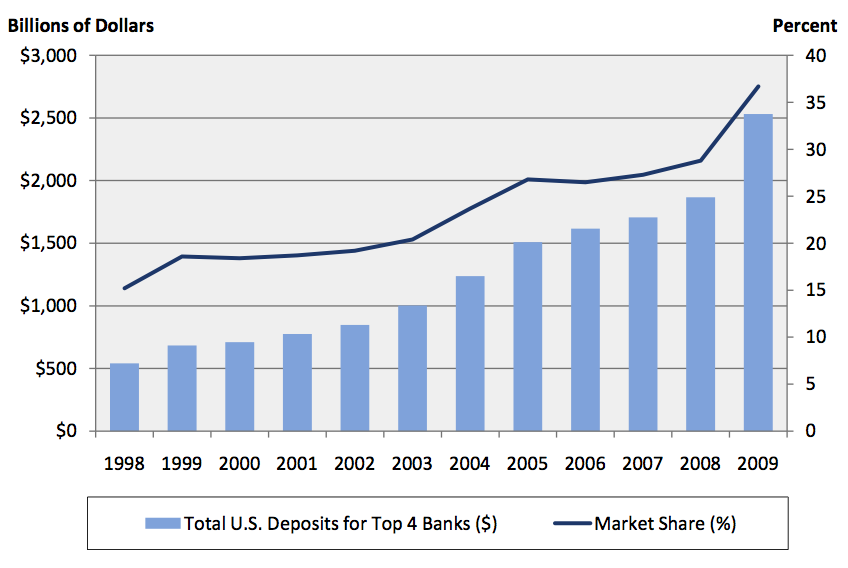
From TARP Oversight Report via TBP.
This week's Gather articles (12/5-12/11):
Web
This week's Gather articles (12/1-12/5):
Health care reform
 | Cool infographic over at The Detroit News about the Cash for Clunkers program by state . Michigan is a clear outlier with a high ratio of buying American instead of foreign cars. Other states are spread . . . more |
 | This Thursday President Obama announced plans to hold a jobs summit in December , in direct response to an unemployment rate at 10.2% ( this non-government estimate puts real unemployment around 22% . . . more |
 | On Monday the Dow Jones Industrial Average stock index hit not only its highest number for 2009 but also over the last year, with a gain of 203.52 points (2.03%) to . . . more |
 | Today the Labor Department reported that the national unemployment rate increased to 10.2%. This marks the highest unemployment rate since 1983 - a 26-year high. This chart from chartoftheday.com . . . more |
NPR has an interactive map up detailing the foreclosure rates, unemployment rates, and median household income by county nationwide. You can zoom in by state and find your county and compare it to . . . more
A good article in The Guardian's Observer section about the possibility of California becoming America's first failed state - and reasons to hope that this won't happen.
Despite increasing pressure from state labor groups, constituents, strong Democratic support, and signs from Republican leaders that they would not obstruct its passage, the unemployment extension bill . . . more
Earlier this week, the House passed a bill to extend unemployment benefits to 29 states in which the average unemployment rate over the last 3 months has been 8.5% or higher. Now it is time for the . . . more
Not sure how, but I get these occasional newsletters from CaseyResearch.com, and this recent one was rather contrarian to say the least. Casey not only says that deflation is a good thing, but he absolutely rips into my beloved Economist (not to mention all those Nobel laureates out there). That got my ire up but I wanted to see what he had to say:
Q: Doug, according to a recent article called "The Greater of Two Evils," The Economist recently stated that inflation is preferable to deflation. What is your take on that?
Doug Casey: It was certainly one of the most ridiculous articles that I have read in recent years. It is disappointing that The Economist is employing the same quality analysts that have populated magazines like Slime and Newspeak for so long -- utterly conventional, thoughtless, and statist in outlook. Everything in this article is not only wrong but the opposite, exactly the opposite of what the truth is.
You know, it is funny. It starts off with a section title saying "Inflation Is Bad, But Deflation Is Worse." No, inflation is very bad, and deflation is actually quite a good thing. I will explain that in a moment. But the first thing that drew my attention in the ridiculous article was a laudatory comment about Paul Krugman, who, they point out, is a Nobel laureate in economics.
My first comment is that the granting of a Nobel Prize in economics is as meaningless and arbitrary as the granting of the Nobel Peace Prize, which is really just a prize in political correctness and whatever appeals to the mob at the moment. These things are all very arbitrary. They have had excellent economists, and they have had anti-economists nominated for the Nobel Prize in Economics. It’s as meaningless an award as the Peace Prize -- which has been given to criminal personalities like Kissinger and Arafat, and buffoons like Al Gore.
[...]
Deflation is actually a good thing, because in a deflation prices drop and money becomes more valuable, so deflation encourages people to save money. Deflation rewards the prudent saver and punishes the profligate borrower. The way a society, like an individual, becomes wealthy is by producing more than it consumes. In other words, by saving, not borrowing. And during a deflation, when money becomes more valuable, everybody wants money. They want to save. Whereas during an inflation, you want to get rid of the money. You want to consume. You want to spend. But you don’t become wealthy by spending and consuming; you become wealthy by producing and saving.
Inflation encourages people to borrow, because they expect to pay the debt off with cheaper dollars. It encourages people to mortgage their future.
Fiery! I enjoy reading contrarian stuff, although Casey comes across as unnecessarily nasty (looks like that's his schtick, now that I check the site a bit). I don't like having to sift good ideas out of irrelevant invective. I think he does hit on a couple good points - 6-12 mos. of low deflation is probably not a bad thing with regard to increasing personal savings rates, encouraging consumer deleveraging, etc. And it certainly makes the current climate of laughable bank savings and CD interest rates more tolerable. But that's not a sustainable situation. Casey doesn't address the inherent problems of the deflationary death spiral (I love that phrase - sounds like some sort of evil econ prof's terror weapon). He also hints at being one of these guys who wants to return to the gold standard and probably has a custom-made vault in his basement to hold his hoard of bullion. The majority of stuff I've read (admittedly a tiny amount) holds that low to moderate inflation is a good thing.
Then again, I slept through Econ 1, so what do I know?
(Also, Mr Casey, the journalists at The Economist make you look like an arrogant windbag.)
Probably not. But what do I know?
For more authoritative opinions, check out this roundtable over at NYT between Simon Johnson, Nicholas Bloom, and Barry Ritholz about the market's rally since its March 9th low. Johnson's all doom and gloom; Bloom's a bit more measured in his take on the situation; Ritholz offers investment strategy more than analysis of the virtues of this recent rally.
(Although Ritholz seems to offer somewhat contradictory advice. If buy and hold is a "losing strategy" in a bear market, then why does he say "For many investors, dollar cost averaging into broad index funds works well" and then actually suggest that they increase their investments during major downturns like the present? "If you want to be a bit aggressive, you can increase your contributions once the markets fall 30 percent or (like now) 50 percent." I think the key here is the difference between active traders and passive buy-and-hold investors - active strategy will change depending on the market situation; for most average investors, passive dollar cost averaging is the way to go regardless of market conditions. And indeed in the case of the latter, increasing that investment during major downturns is a way to pick up extra shares on the cheap.)
A cartoon from the Chicago Tribune, 1934. The refrain sounds so familiar, doesn't it? (Click to enlarge.)
Via the increasingly indispensable Big Picture.
I find it fascinating to see how the economy affects everyday things that one might not otherwise give a second thought to. I thought this was a neat snippet:
Via Planet Money.Beerzie Boy writes from Sacramento:
We have a soda machine at work that, like most soda machines, can be persnickety about taking bills when they are wrinkled. You have to smooth the bill and unfold the corners perfectly to get the bill to go into the machine. Last year about this time, I could not get the machine to take a dollar bill, no matter how flat and perfect it was, so I would always have to use change to get a soda. It was a real pain, because I often didn't have change and would have to pester my co-workers to get some. One day when I saw the vending machine guy filling the machine, I asked him why this was happening. He told me that when the machine gets full of bills, it refuses to take any more. Pretty simple.
Recently, the opposite started to happen: I would try to use change, and it would refuse to take it and dump it in the coin return. At first it only refused quarters, then it started to refuse dimes, then nickels. Now it will only take bills. When I saw the vending machine guy he said -- you have probably guessed it -- that the coin bins were filling faster than the bill bin. He also said this was becoming more common on the machines on his route. So I guess that people are digging deeper into their purses, piggy banks, and car ashtrays for the money to get their daily soda fix, and saving their bills for more important things.
Check out this interactive chart over at CNNMoney.com. It shows the total amount of money involved in the economic rescue itemized by program: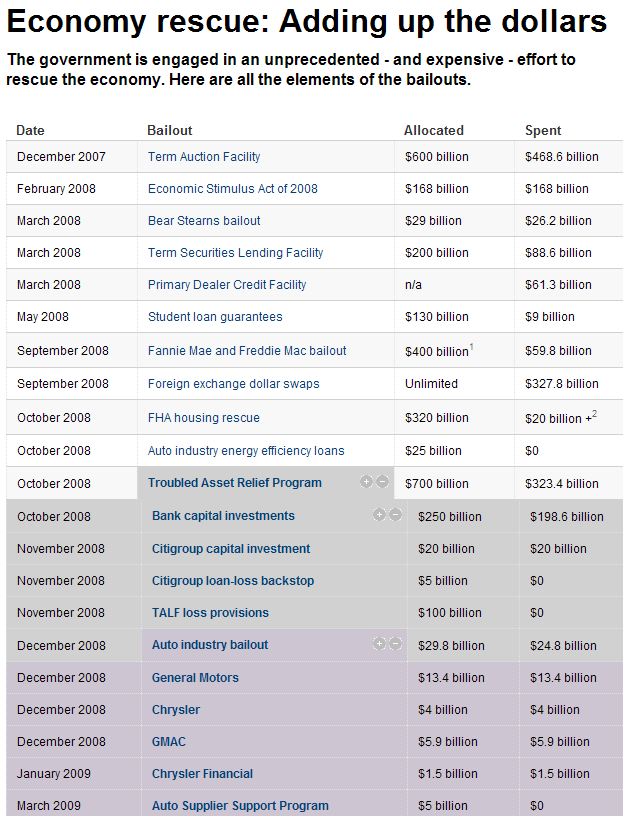
$2.6 trillion - and that's only a quarter of the total allocated!
Can a brother hold a couple big dimes?
Via Ritholz.
One of the possible upsides of this crisis is that we might once again have a reasonable national savings rate. As recently as three years ago we were, as a country, spending more than 100% of our income. The ensuing credit bubble, fed in no small part by ballooning home prices, was a big factor in EconoShitstorm '08. Check out the graph below for perspective on historical personal savings rates:
Sometimes an existential crisis is required for us to make fundamental changes as a society.
Via Planet Money.
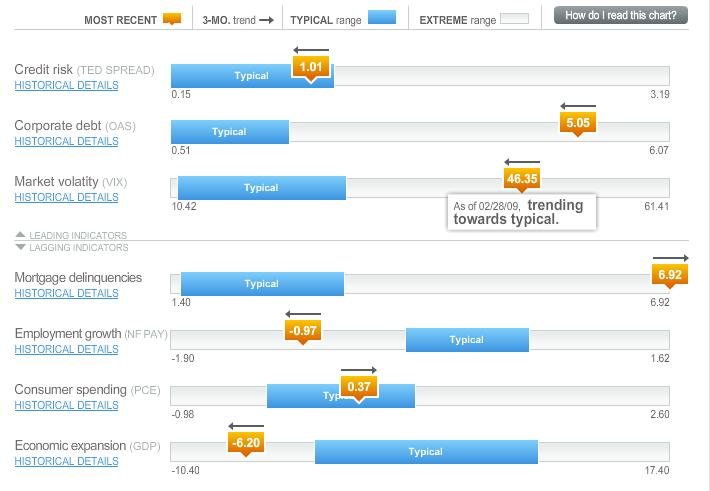
Intriguing, cool interactive graphic over at Russel.com. Definitely visit to dig down and learn about all these indicators, what they are, and what they mean. Maybe you can explain it to me, because I don't know what the hell I'm looking at here.
Leading indicators trending toward (although a ways off from) typical, at least. So we've got that going for us.
Hm, upon examining closer it looks like the data is as of 2/28...which makes sense. In a few days we should be able to get the numbers from March. You can subscribe to an email update if you follow this link.
Via Ritholz @ The Big Picture - a must-read (good mix of broad analysis of the financial crisis, interviews, guest authors, in-depth market/investing stuff, and a fair amount of humorous bits as well) during these tumultuous times.
Hat tip to RAW for turning me on to that blog. (Who still has to answer the email I sent him about...two weeks ago? WTF, man?)


