You should, too. If properly implemented, President Obama's proposal will go a long way towards mitigating the systemic risk that "too big to fail" financial institutions pose to our economy. No single institution should be TBTF. Shrink the morbidly obese oligarchs. There will still be plenty of profit to keep them all fat and giggly without relying on the taxpayer to fund high-risk speculative soilage the next time around.
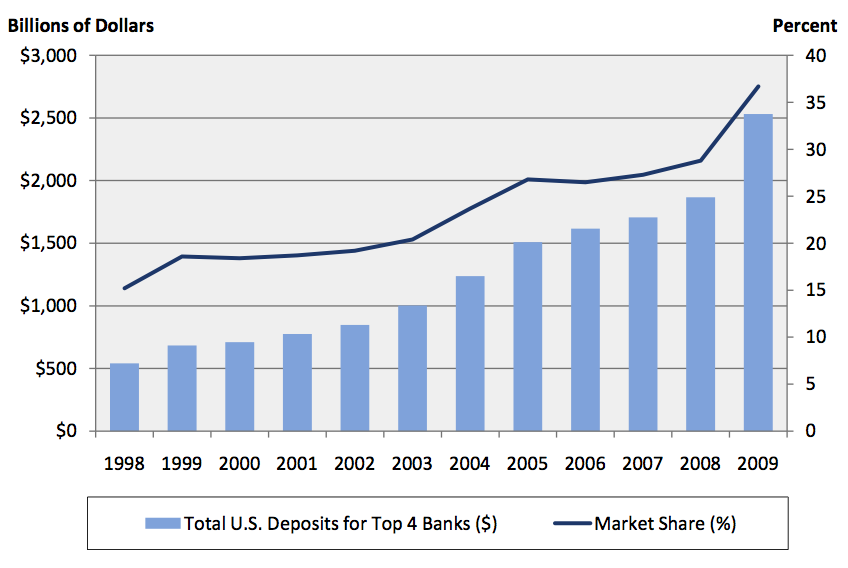
What do we do in response to a financial crisis due in no small part to the systemic risk posed by institutions that by their very size prove essential to a functioning financial system? Gorge them on taxpayer funds so they get even bigger, while smaller banks without the benefit of implicit government guarantee are allowed to fail (as all insolvent businesses should):
Despite a rally of over 50% since its March low, put in a historical context of previous market rallies this current one by the Dow Jones Industrial Average is both short in duration and small in magnitude. . . .more
On Monday the Dow Jones Industrial Average stock index hit not only its highest number for 2009 but also over the last year, with a gain of 203.52 points (2.03%) to . . .more
In a surprising move, the board of Berkshire Hathaway has approved a decision to split the company's Class B common stock shares at a ratio of 50-for 1. Berkshire Hathaway Chairman Warren Buffett . . .more
Nobody even tries to hide this any longer. The only way they could make it more blatant is if they hung a huge Goldman Sachs logo on the Capitol dome and then branded it onto the foreheads of leading members of Congress and executive branch officials.
Quoted in the article, this doozy from Matt Taibbi:
That’s why even people like [Glenn] Beck’s audience, who I’d wager are mostly lower-income people, can’t imagine themselves protesting against the Wall Street barons who in actuality are the ones who fucked them over. . . .
Actual rich people can’t ever be the target. It’s a classic peasant mentality: going into fits of groveling and bowing whenever the master’s carriage rides by, then fuming against the Turks in Crimea or the Jews in the Pale or whoever after spending fifteen hard hours in the fields. You know you’re a peasant when you worship the very people who are right now, this minute, conning you and taking your shit. Whatever the master does, you’re on board. When you get frisky, he sticks a big cross in the middle of your village, and you spend the rest of your life praying to it with big googly eyes. Or he puts out newspapers full of innuendo about this or that faraway group and you immediately salute and rush off to join the hate squad. A good peasant is loyal, simpleminded, and full of misdirected anger. And that’s what we’ve got now, a lot of misdirected anger searching around for a non-target to mis-punish . . . can’t be mad at AIG, can’t be mad at Citi or Goldman Sachs. The real villains have to be the anti-AIG protesters! After all, those people earned those bonuses! If ever there was a textbook case of peasant thinking, it’s struggling middle-class Americans burned up in defense of taxpayer-funded bonuses to millionaires. It’s really weird stuff.
And don't forget:
One might think it would be a big news story for the second most-powerful member of the U.S. Senate to baldly state that the Congress is "owned" by the bankers who spawned the financial crisis and continue to dictate the government's actions. But it won't be.
Indeed. Ah, America!
Greenwald over at Salon. Good stuff, if you don't mind vomiting after reading.
I've been watching several excellent videos explaining the Geithner Public-Private Investment Partnership (PPIP) plan over at the YouTubes courtesy of Salman Khan of the Khan Academy. Khan explains things clearly and effectively with simple visual aids.
If you're confused about the plan (and confusing it is) then check out Khan's series. He starts off explaining the basics of how the plan works and then in "Geithner II" raises the disturbing point that these banks could buy these assets from themselves - via special investment vehicles, hedge funds, or other independent entities associated with the banks - in effect recapitalizing themselves by shoring up balance sheets with a fat government subsidy:
This does seem like an almost foregone conclusion unless the gov't can somehow prevent it through legal means...but I'm not sure they can. Even if the banks do an end-around here, it might actually work in terms of recapitalizing the banks and avoiding insolvency, but it would essentially be an indirect bailout, which is extremely distasteful right now. I'm more or less in agreement with Khan and the Krugman/Johnson camp - the sooner we nationalize these institutions ("nationalize" in the sense of putting them into FDIC receivership, recapitalization, and eventual reprivatization) - the sooner we can rebound from this crisis. Even if the PPIP works to keep the banks functioning, it does so at great expense to the taxpayer and does nothing to address the systemic risk of these "too big to fail" banks. I'd prefer the definite path of nationalization rather than this pseudo-nationalization by way of enormous gov't subsidy.
In his latest video, "Geithner 5: A better solution," Khan addresses the problem which the PPIP is intended to solve - that of a lack of information about these toxic assets and liquidity (ignoring for the moment the high likelihood that it's as much as or even more of a solvency problem than a liquidity one). He has a great idea, similar to the one I mentioned here, to open up the market to all investors and provide detailed information on all these toxic assets. Basically list these assets as shares of corporations (owned by their respective banks) on the New York Stock Exchange and allow anyone to purchase shares. At the moment these assets are only available to institutional or large net worth investors via hedge funds and the like; mincing them into thousands of shares would allow access to Phil Everyman. Aside from the idea that individual investors should be able to receive the benefits of the "Geithner put" just like hedge funds, Khan's idea solves both the lack of information and liquidity problems:
There are details to be worked out in the execution, of course. The analysis and summaries of the assets as he describes would take some time and a lot of hard work on the part of some smart people, but it's something that, once done, would allow any individual with a modicum of means to invest in these assets.
I find this stuff fascinating, intimidating, and troubling all at once.
Remember this? A year ago to the day I posted about this video, Money As Debt:
It's interesting to watch this again given the current crisis. Ignoring the paranoia/conspiracy overtones for now, we are seeing the main theme of the video act itself out to a large degree. We're seeing the fallout from the collapse of the huge credit bubble that grew in the last decade. We're seeing how enormous money center banks and similar financial entities - Citi, Bank of America, AIG - are by their essential nature holding the U.S. Government - and thus the American taxpayer - hostage. These banks that are "too big to fail," necessarily protected by a doctrine implicit in that belief, having failed to function effectively in a poorly-regulated free market, are now dependent on support from the very people that are suffering due to the negligence, poor risk management, and gross incompetence of these banks.
Moving forward we cannot allow "too big to fail" to exist because it carries with it an inherent risk to the health of the financial system.
Did you listen to me then? Probably not. You so rarely do. It's the lack of communication that's missing in this relationship.
Well Suze and TD Ameritrade are still offering the deal, although it's now a min. of $100/mo. Still a fantastic deal. Simply sign up for the money market deposit account at TD Ameritrade with automatic deposits of at least $100/mo. for 12 months and 4 weeks from the 12th deposit you will receive $100. Takes about 10 min. to set up. Set it and forget it.
I just received my $100 after signing up for this program in Feb last year, so I can confirm this is a no-BS good deal. Visual proof:
The MMDA has a paltry 0.5% interest rate but who cares with that fat bonus at the end? In this economy that's one of the best investments you'll find.
In recent months I've taken to listening to several quality podcasts:
EconTalk: Russ Roberts of the Library of Economics and Liberty (econlib.org) and George Mason University hosts this weekly hour-long podcast with some big name guests on deep economic issues. Heady, fascinating, and frankly frightening stuff given our current climate. The most intellectually demanding of the bunch.
NPR: Planet Money: Laura Conaway and David Kestenbaum host these 20-minute shows that usually touch upon a couple different issues, including both macro-economic and personal finance topics. Often has regular folks call in with stories about unemployment, banking, and other PF issues. Pleasant hosts, often pretty funny, and packed with good news and info.
Vanguard: Plain Talk on Investing: A somewhat irregular (ranging from weekly to monthly) podcast with short 8-10 minute episodes about specific investing topics. Simple, quality, digestible advice. I look forward to applying some of this once I am able to generate some investable assets once again!
A preponderance of NPR, no?
Also this now-defunct podcast was simply astounding in its time. Content was meh but listen to the smooth sounds of the Velvet Fog on the narration!
Click here to download Suze Orman's 2009 Action Plan (pdf) for free until January 15th. I breezed through the applicable sections in this in a short time. Financial guru Orman has a nice, concise history of how this whole economic poopfest started, and provides a lot of solid advice from general strategies to specific scenarios and plans (e.g. "I owe credit card debt and I want to tap my 401(k) to reduce it. What should I do?").
Something in there for everyone. Download it and check it out. It's free, after all, and that's about all I can afford these days!
Where does money come from? What is "money," exactly? It's printed by the Federal Government, right? Not exactly. In fact, almost all of the money in existence is created every day, quite literally out of nothing, to contribute to an exponentially-increasing economic bubble which is fundamentally flawed - to the point that it is unsustainable.
Check out Paul Grignon's 47-minute animated film for a shocking, revelatory look at our monetary system.
I recently got referred to this new service: Revolution Money Exchange. It appears to be similar to PayPal for free online money transactions. If you get a referral from me you can get a $25 bonus just for opening up an account. Then you can withdraw it after a few days of verification. Hard to beat free cash! Shoot me an email at mrhe25@gmail.com for a referral.
I just signed up for this great offer. Suze Orman has a deal with TD Ameritrade: If you open up an account with them before March 31 using the code on that page and set up an automatic deposit of at least $50/month for 12 months, they will give you $100 within 4 weeks of the final deposit! No need to get involved with the actual trading aspects of TD Ameritrade, either. Your cash is put into a money market deposit account which earns 2.78% APY. That isn't the best rate out there, but still decent, and it's impossible to beat the return on that total $600 invested over 12 months. (It would equal about 32% compound interest at $50/mo.) This one's a no-brainer; everyone should be able to spare $50/mo. And after a year you'll have more than $700 that you can withdraw and put toward whatever you like. Click here to check it out!
I found out about this over at My Money Blog, which has a lot of great tips on making extra cash, bank rates, rewards credit cards, and more.
A great article in this Sunday's NYT Magazine about Ben Bernanke and the Federal Reserve - who they are, what they do, and how much influence they have on the economy. Illuminating for those of us who see the Fed chief as some sort of economic wizard dabbling in the arcane arts. Interesting stuff - especially considering this headline this morning.
I just did my taxes and realize that I owe you a ridiculous amount of money. How wonderful! I was just thinking the other day, "Wow, I made so much money last year; I wish I were legally compelled to shell out an enormous percentage of my income to the federal government come April 15th!" People talk about things like food, shelter, etc. - these are just the trappings of a life of luxury. Heaven forfend I should have enough money in the bank to spoil myself with groceries this month! To tack on an obscene obligatory expenditure to my already taxed (pun intended!) finances - I should like that of all things!