Showing posts with label World War II. Show all posts

Sunday, March 8, 2009

Cartographic Violence

A nod to ("Hot" )foot for bringing this recent Strange Maps post to my attention. It's a funny cartoon about WW II featuring the countries as characters. Check it out. Because if you're wasting time reading this blog, you might as well laugh, right?

Sunday, May 25, 2008

The Great Escape


This film is amazing. I've seen it several times and it draws me in whenever it's on AMC. Fantastic - yes, it takes a few liberties with the true story (including Steve McQueen's motorcycle scene, which was an entirely self-aggrandizing act - but tremendously awesome nonetheless) but it is a great film. Allied chutzpah, sticking it to the Nazis, lots of comic relief, a fantastic cast with Attenborough, McQueen, Garner, and Bronson - just fantastic.

I first saw this when I was probably ten or so, when it came on TV and my Dad told me that it was a great movie. I listened and watched - as should you*.

*If you happen to like awesome '60's WWII movies packed with huge stars that are more or less factually accurate but contain some Hollywood glitz yet are tremendously patriotic and uplifting and if you don't shed a few tears at the end of which you are a soulless shell of a human being.

This was back in the glory days, when they made legitimate epics which spanned 3+ hrs. of film with nary a wasted scene.

Also - the music!

Monday, April 28, 2008

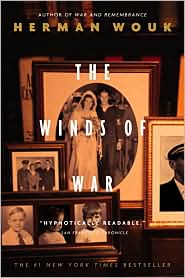
The Winds of War


Peace, if it ever exists, will not be based on the fear of war, but on the love of peace. It will not be the abstaining from an act, but the coming of a state of mind. In this sense the most insignificant writer can serve peace, where the most powerful tribunals can do nothing.

-Julien Benda, a French Jew

So reads the quotation in the foreword to The Winds of War, by Herman Wouk. This book is without a doubt the best $0.25 I have ever spent. War is an epic novel of World War II. It follows the Henry family from the summer of 1939 up until December of 1941, just after the Japanese attack on Pearl Harbor. The Henrys are the archetypical Navy family. Victor "Pug" Henry is a captain, getting up there in age, watching his Annapolis classmates get promotions and prestigious commands while he remains stuck on land. He yearns for command of a "battlewagon" - one of the several battleships which symbolize the United States' naval power. His wife, Rhoda, feels the same way, and though their marriage is strong, it grows stale. She envies the wives of Pug's more successful peers. The Henrys' eldest son, Warren, is a cocksure young lieutenant who becomes a naval aviator, flying the Douglass SBD Dauntless. Byron, although he was Navy ROTC, is a nominal academic, having pursued a somewhat aimless career in art history. He is now off in Italy, working for a famous Jewish author and his niece. Eventually he becomes a submariner as the likelihood of the US entering the war grows greater. Madeline has just graduated from college and is on her own in New York City, working in the glamorous radio business - much to the chagrin of conservative, religious Pug.

The book is about the lead-up to America's entrance into the war, and describes in detail the mentality in the US before Pearl Harbor. Many characters in the book - Americans and Britons among others - respect Hitler as a leader for having reinvigorated Germany after the embarrassment of Versailles. Although many agree that some of Hitler's anti-Semitic policies are "excessive," there is little in the way of sympathy for European Jews from the average American. Wouk does a good job of capturing the insidious anti-Semitism of the period - both the subtle, casual anti-Semitism manifested in offhand comments and the "us and them" mentality of people like the otherwise virtuous Henry; and the blatant, pervasive racism that gave Hitler and his cronies the moral authority to perpetrate unprecedented evil against the European Jewry, culminating in the Holocaust.

The Henry family is buffeted by the winds of war: Hitler's invasion of Poland and the Sitzkrieg; the invasions of France and Norway; the Battle of Britain; the invasion of the Soviet Union; and the attack on Pearl Harbor. In the midst of all this the Henry sons fall in love and Pug and Rhoda's marriage is put to the test as Pug is off in numerous countries as special naval attaché. Although this is still a desk job, it is important, and provides him not only with the ear of President Roosevelt, but also gives him the opportunity to meet a cast of the major characters of the period - Hitler, Ribbentrop, Goering, Mussolini, Churchill, and Stalin. While the scenario perhaps stretches credibility a bit, it provides the reader with an excellent opportunity to "meet" these imposing historical personages and makes for fascinating reading.

There's so much going on that it's impossible to touch upon everything, but the reader sees most of the major events of the initial years of war either directly through the novel's main characters (Byron finds himself caught in Warsaw during the blitzkrieg, for instance) or indirectly as news of events in Europe reach America. Although it is widely believed that America will not fight a war to "save the Jews," the threat of Japan in the Pacific is growing and war with the Empire of the rising Sun is seen as inevitable.

The Winds of War is an excellent novel. One of the best I have read. Its scope is impressive and its characters are compelling. As a history buff, I found its attention to detail and historical accuracy amazing. As major events occur in the novel, Wouk provides excerpts from World Empire Lost, a historical work by the fictional German General Armin von Roon, translated into English after the war by Victor Henry. These excerpts provide the reader with a historical exposition of sorts to help the reader understand the big picture of the war as it develops, and also show the German point of view. Very interesting to read.

Despite the fact that it's a 1,000-plus page novel, it feels like an introduction. It was surprisingly readable for a novel of its size and depth, and it was probably the fastest 1,000 pages I've ever read. It ends just as Congress votes for a declaration of war on the Empire of Japan, with the so-called Arsenal of Democracy gearing up to defeat fascism on both sides of the globe. I am very much looking forward to reading the sequel, War and Remembrance. I recommend this highly.

Friday, March 28, 2008

Did the Blitz Save Britain?

An interesting article about the German bombing of London during World War II over at TheAtlantic.com. In part it's a critique of Peter Stansky's book, The First Day of the Blitz. A couple good points in there about how the start of intense bombing raids on London came at a decisive point during the Battle of Britain, and marked a shift in German strategy than may have enabled the RAF to recover enough to finally repel the Luftwaffe. Good stuff by way of Arts & Letters Daily, a nice collection of links to articles, book reviews, essays, and opinion pieces (hat tip to Dad for turning me onto this).

Wednesday, November 21, 2007

Mein Kampf vs. The Al Qaeda Reader

Raymond Ibrahim has a fascinating article up at the National Review Online, posted here on VDH's Private Papers. Ibrahim, translator and editor of The Al Qaeda Reader, addresses the similarities and differences between Adolf Hitler's polemical Mein Kampf and the Reader, a collection of documents assembled by al Qaeda founders Osama bin Laden and Ayman al-Zawahiri in order to indoctrinate Muslims to their particular brand of fanatic Islamism.

Ibrahim's article is disturbing, as much for the differences between the two texts as for the similarities. Both texts are expressly anti-democratic, militaristic, expansionist, and pervasively anti-Semitic. The Al Qaeda Reader is even more blatant than Mein Kampf in its unyielding stance on achieving world domination. Negotiation is unacceptable and the "infidel" must submit to Allah or be killed. Both texts appeal to ideals of heroism and self sacrifice while bemoaning the decadence of the West.

It is at first surprising how similar the two texts are according to the excerpts that Ibrahim presents, but it makes sense when one considers that both ideologies - Hitler's eugenic fascism on the one hand and al Qaeda's Islamo-fascism on the other - stem from a perceived victimization at the hands of the world Jewry, allegedly responsible for the moral degradation of the Western democracies.

What is unsettling about the contrast between the two texts is that Hitler's was a secular ideology, and while virulent, destructive, and evil in the extreme, an ideology that was nevertheless soundly defeated by the so-called Arsenal of Democracy in the immediate military sense (with rather a significant part played by the Communists), and that has largely lost credence in the half-century since with the spread of progressive, liberal democratic ideals. Mein Kampf was written by a single man, and from what I understand it is to a large degree a treatise wrapped up in Hitler's personal experience.

The Al Qaeda Reader, however, was not written by one man, nor is it a secular polemic. As Ibrahim says, about half of the Reader comprises quotations, from the Koran, Muhammad himself (hadith), and authoritative Islamic theologians, collected and assembled by bin Laden and al-Zawahiri. The anti-Semitic, illiberal, anti-democratic, expansionist, fascistic version of Islam presented in the Reader isn't a hodgepodge of crackpot extremism cooked up by a couple of nutjobs in an Afghani cave, but rather a worldview fundamental to Islam, firmly supported by the ultimate theological authorities. It is easy to discredit and defeat secular extremism with liberal, rational thought. It is far more difficult to defeat an ideology that has theological tenets entirely antithetical to religious pluralism, democracy, diplomacy, and liberalism.

When you argue against a secular ideology you are merely in disagreement with a man; when you argue against an ideology grounded in theology you are, ipso facto, an infidel.

And that's a tough obstacle to overcome.

Monday, September 3, 2007

Ordinary Heroes


In Ordinary Heroes, Scott Turow moves away from his usual legal thrillers and pens a novel about World War II that is part mystery, part historical fiction, and part family drama. Stewart Dubinsky is a retired journalist who comes across his father's papers dating from his service in the war. Stewart's dad, David, never really spoke much of his wartime experience while Stewart was growing up. It was something that was in the past and Stewart never pressed him for more information. The adult Stewart is then shocked to discover in these papers that his father was court-martialed and imprisoned shortly in the closing months of the war, and for some reason pardoned and released.

Stewart delves into his father's account - essentially a lengthy letter written to his lawyer in partial explanation of the events leading up to his arrest and trial. It contains some pretty incredible first-person accounts of the late stages of the war in France and Germany. Stewart learns of his father's mission - as a JAG lawyer attached to Patton's Third Army, David was ordered to locate and apprehend a rogue American officer. Major Richard Martin was a highly lauded OSS operative who had been very successful in espionage, sabotage, and wreaking general havoc behind the German lines. However, Martin cut off contact with his superiors and went "off the reservation" as they say, holing up in a chateau with his beautiful partisan companion Gita.

Stewart learns a great deal about his father's experience through reading his papers. Ordinary Heroes is a great read - it's engrossing, fast-moving, and contains several threads of mystery running throughout a gritty portrayal of that most brutal of wars. I recommend it - great beach reading. It's on the lighter side - not fluff - but certainly not overly literary.