Showing posts with label War. Show all posts

Monday, November 9, 2009

Chavez tells Venezuela troops to "prepare for war" with Colombia

President Hugo Chavez of Venezuela ratcheted up the brinksmanship to extreme levels today as he mobilized 15,000 troops and sent them to the border Venezuela shares with Colombia. The leftist dictator . . . more

Monday, November 17, 2008

The Bixby Letter

Interesting article about a possible authentic copy of Abraham Lincoln's famed "Bixby Letter" buried in the archives of the Dallas Historical Society.

Here's the text of the Bixby Letter:

Executive Mansion, Washington, Nov 21, 1864
To Mrs. Bixby, Boston, Mass.

Dear Madam,

I have been shown in the files of the War Department a statement of the Adjutant-General of Massachusetts, that you are the mother of five (5) sons who have died gloriously on the field of battle.

I feel how weak and fruitless must be any word of mine which should attempt to beguile you from the grief of a loss so overwhelming. But I cannot refrain from tendering you the consolation that may be found in the thanks of the republic they died to save.

I pray that our Heavenly Father may assuage the anguish of your bereavement, and leave you only the cherished memory of the loved and lost, and the solemn pride that must be yours to have laid so costly a sacrifice upon the altar of freedom.

Yours, very sincerely and respectfully,
A Lincoln

Five sons.

Sunday, May 25, 2008

The Great Escape


This film is amazing. I've seen it several times and it draws me in whenever it's on AMC. Fantastic - yes, it takes a few liberties with the true story (including Steve McQueen's motorcycle scene, which was an entirely self-aggrandizing act - but tremendously awesome nonetheless) but it is a great film. Allied chutzpah, sticking it to the Nazis, lots of comic relief, a fantastic cast with Attenborough, McQueen, Garner, and Bronson - just fantastic.

I first saw this when I was probably ten or so, when it came on TV and my Dad told me that it was a great movie. I listened and watched - as should you*.

*If you happen to like awesome '60's WWII movies packed with huge stars that are more or less factually accurate but contain some Hollywood glitz yet are tremendously patriotic and uplifting and if you don't shed a few tears at the end of which you are a soulless shell of a human being.

This was back in the glory days, when they made legitimate epics which spanned 3+ hrs. of film with nary a wasted scene.

Also - the music!

Friday, May 2, 2008

Art from the Great War

Very cool recent post over at Strange Maps.

Monday, April 28, 2008

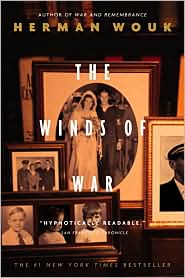
The Winds of War


Peace, if it ever exists, will not be based on the fear of war, but on the love of peace. It will not be the abstaining from an act, but the coming of a state of mind. In this sense the most insignificant writer can serve peace, where the most powerful tribunals can do nothing.

-Julien Benda, a French Jew

So reads the quotation in the foreword to The Winds of War, by Herman Wouk. This book is without a doubt the best $0.25 I have ever spent. War is an epic novel of World War II. It follows the Henry family from the summer of 1939 up until December of 1941, just after the Japanese attack on Pearl Harbor. The Henrys are the archetypical Navy family. Victor "Pug" Henry is a captain, getting up there in age, watching his Annapolis classmates get promotions and prestigious commands while he remains stuck on land. He yearns for command of a "battlewagon" - one of the several battleships which symbolize the United States' naval power. His wife, Rhoda, feels the same way, and though their marriage is strong, it grows stale. She envies the wives of Pug's more successful peers. The Henrys' eldest son, Warren, is a cocksure young lieutenant who becomes a naval aviator, flying the Douglass SBD Dauntless. Byron, although he was Navy ROTC, is a nominal academic, having pursued a somewhat aimless career in art history. He is now off in Italy, working for a famous Jewish author and his niece. Eventually he becomes a submariner as the likelihood of the US entering the war grows greater. Madeline has just graduated from college and is on her own in New York City, working in the glamorous radio business - much to the chagrin of conservative, religious Pug.

The book is about the lead-up to America's entrance into the war, and describes in detail the mentality in the US before Pearl Harbor. Many characters in the book - Americans and Britons among others - respect Hitler as a leader for having reinvigorated Germany after the embarrassment of Versailles. Although many agree that some of Hitler's anti-Semitic policies are "excessive," there is little in the way of sympathy for European Jews from the average American. Wouk does a good job of capturing the insidious anti-Semitism of the period - both the subtle, casual anti-Semitism manifested in offhand comments and the "us and them" mentality of people like the otherwise virtuous Henry; and the blatant, pervasive racism that gave Hitler and his cronies the moral authority to perpetrate unprecedented evil against the European Jewry, culminating in the Holocaust.

The Henry family is buffeted by the winds of war: Hitler's invasion of Poland and the Sitzkrieg; the invasions of France and Norway; the Battle of Britain; the invasion of the Soviet Union; and the attack on Pearl Harbor. In the midst of all this the Henry sons fall in love and Pug and Rhoda's marriage is put to the test as Pug is off in numerous countries as special naval attaché. Although this is still a desk job, it is important, and provides him not only with the ear of President Roosevelt, but also gives him the opportunity to meet a cast of the major characters of the period - Hitler, Ribbentrop, Goering, Mussolini, Churchill, and Stalin. While the scenario perhaps stretches credibility a bit, it provides the reader with an excellent opportunity to "meet" these imposing historical personages and makes for fascinating reading.

There's so much going on that it's impossible to touch upon everything, but the reader sees most of the major events of the initial years of war either directly through the novel's main characters (Byron finds himself caught in Warsaw during the blitzkrieg, for instance) or indirectly as news of events in Europe reach America. Although it is widely believed that America will not fight a war to "save the Jews," the threat of Japan in the Pacific is growing and war with the Empire of the rising Sun is seen as inevitable.

The Winds of War is an excellent novel. One of the best I have read. Its scope is impressive and its characters are compelling. As a history buff, I found its attention to detail and historical accuracy amazing. As major events occur in the novel, Wouk provides excerpts from World Empire Lost, a historical work by the fictional German General Armin von Roon, translated into English after the war by Victor Henry. These excerpts provide the reader with a historical exposition of sorts to help the reader understand the big picture of the war as it develops, and also show the German point of view. Very interesting to read.

Despite the fact that it's a 1,000-plus page novel, it feels like an introduction. It was surprisingly readable for a novel of its size and depth, and it was probably the fastest 1,000 pages I've ever read. It ends just as Congress votes for a declaration of war on the Empire of Japan, with the so-called Arsenal of Democracy gearing up to defeat fascism on both sides of the globe. I am very much looking forward to reading the sequel, War and Remembrance. I recommend this highly.

Saturday, April 5, 2008

Infographics: Iraq et al.

Check out this infographic packed with data about the Iraq War and occupation. Click on the image to enlarge. I'll let you draw your own conclusions. From ForeignPolicy.com, by way of The Dough Roller.


Also came across this blog: Cool Infographics. Reminds me of Strange Maps - very specific, interesting, unique subject matter. Cool stuff. Check it out.

Friday, March 28, 2008

Did the Blitz Save Britain?

An interesting article about the German bombing of London during World War II over at TheAtlantic.com. In part it's a critique of Peter Stansky's book, The First Day of the Blitz. A couple good points in there about how the start of intense bombing raids on London came at a decisive point during the Battle of Britain, and marked a shift in German strategy than may have enabled the RAF to recover enough to finally repel the Luftwaffe. Good stuff by way of Arts & Letters Daily, a nice collection of links to articles, book reviews, essays, and opinion pieces (hat tip to Dad for turning me onto this).

Friday, February 15, 2008

The Disappearance of European Violence

Geoffrey Wheatcroft discusses James Sheehan's Where Have All the Soldiers Gone, a book about Europe's demilitarization over the last 60 years. Interesting commentary.

Wednesday, January 9, 2008

A Soldier's Declaration

The following letter was written by a soldier in combat to the powers that be back home:

I am making this statement as an act of wilful defiance of military authority because I believe that the war is being deliberately prolonged by those who have the power to end it. I am a soldier, convinced that I am acting on behalf of soldiers. I believe that the war upon which I entered as a war of defence and liberation has now become a war of agression and conquest. I believe that the purposes for which I and my fellow soldiers entered upon this war should have been so clearly stated as to have made it impossible to change them and that had this been done the objects which actuated us would now be attainable by negotiation.

I have seen and endured the sufferings of the troops and I can no longer be a party to prolonging these sufferings for ends which I believe to be evil and unjust. I am not protesting against the conduct of the war, but against the political errors and insincerities for which the fighting men are being sacrificed.

On behalf of those who are suffering now, I make this protest against the deception which is being practised upon them; also I believe it may help to destroy the callous complacency with which the majority of those at home regard the continuance of agonies which they do not share and which they have not have enough imagination to realise.

Sound at all familiar?

It was written by Lt. Siegfried Sassoon, 3rd Battaltion, Royal Welsh Fusiliers, in July of 1917. It was a statement to his commanding officer declining his return to duty. It was read aloud in the House of Commons and printed in the London Times the following day.

I'm just posting it here without any comment on my particular feelings toward the ongoing war in Iraq because as I read it I thought, "Wow, this could very well have been written today." (Save the last paragraph; I hardly think we are "complacent" back home.) I guess my point is, in part, that history repeats itself; that the full effect of current events is not realized until years, often decades hence; and that no matter what the era, conflict, or reasons for it, violence as national policy is an unfortunate (but sometimes necessary) evil.

Source: Wikipedia.org

Saturday, November 24, 2007

Mystery of the Russian Royal Family Finally Solved


This is very cool - the clue to the missing bodies was right there all along. Pretty interesting stuff.

Wednesday, November 21, 2007

Mein Kampf vs. The Al Qaeda Reader

Raymond Ibrahim has a fascinating article up at the National Review Online, posted here on VDH's Private Papers. Ibrahim, translator and editor of The Al Qaeda Reader, addresses the similarities and differences between Adolf Hitler's polemical Mein Kampf and the Reader, a collection of documents assembled by al Qaeda founders Osama bin Laden and Ayman al-Zawahiri in order to indoctrinate Muslims to their particular brand of fanatic Islamism.

Ibrahim's article is disturbing, as much for the differences between the two texts as for the similarities. Both texts are expressly anti-democratic, militaristic, expansionist, and pervasively anti-Semitic. The Al Qaeda Reader is even more blatant than Mein Kampf in its unyielding stance on achieving world domination. Negotiation is unacceptable and the "infidel" must submit to Allah or be killed. Both texts appeal to ideals of heroism and self sacrifice while bemoaning the decadence of the West.

It is at first surprising how similar the two texts are according to the excerpts that Ibrahim presents, but it makes sense when one considers that both ideologies - Hitler's eugenic fascism on the one hand and al Qaeda's Islamo-fascism on the other - stem from a perceived victimization at the hands of the world Jewry, allegedly responsible for the moral degradation of the Western democracies.

What is unsettling about the contrast between the two texts is that Hitler's was a secular ideology, and while virulent, destructive, and evil in the extreme, an ideology that was nevertheless soundly defeated by the so-called Arsenal of Democracy in the immediate military sense (with rather a significant part played by the Communists), and that has largely lost credence in the half-century since with the spread of progressive, liberal democratic ideals. Mein Kampf was written by a single man, and from what I understand it is to a large degree a treatise wrapped up in Hitler's personal experience.

The Al Qaeda Reader, however, was not written by one man, nor is it a secular polemic. As Ibrahim says, about half of the Reader comprises quotations, from the Koran, Muhammad himself (hadith), and authoritative Islamic theologians, collected and assembled by bin Laden and al-Zawahiri. The anti-Semitic, illiberal, anti-democratic, expansionist, fascistic version of Islam presented in the Reader isn't a hodgepodge of crackpot extremism cooked up by a couple of nutjobs in an Afghani cave, but rather a worldview fundamental to Islam, firmly supported by the ultimate theological authorities. It is easy to discredit and defeat secular extremism with liberal, rational thought. It is far more difficult to defeat an ideology that has theological tenets entirely antithetical to religious pluralism, democracy, diplomacy, and liberalism.

When you argue against a secular ideology you are merely in disagreement with a man; when you argue against an ideology grounded in theology you are, ipso facto, an infidel.

And that's a tough obstacle to overcome.

Tuesday, November 13, 2007

A Day Late (Apologies to the Veterans)

Hanson says it better than I can, but:

Thank you, Chris, Bryan, Teresa, Nichole; other friends and family; and countless veterans, past, present, and future; who suffer hardship, pain, and death - without control over the policies which demand it of them - so that the rest of us can live relatively unaffected by so much of the evil in this world.

Happy Veterans Day.

Monday, September 24, 2007

Submit - or else?

Raymond Ibrahim has a nice article up at VDH's Private Papers. It's important for us to understand exactly who and what we are facing in this so-called War on Terror, and comprehending the nuances of language as Ibrahim discusses is one step along a very long and difficult path.

For all its legions of moderate practitioners, there is no avoiding the fact that Islam has as its essential tenet - the very name of the religion itself! - worldwide submission to Allah by will or by force.

This poses an intractable problem for any truly effective dialogue between the liberal, religiously plural West and the unyielding, dogmatic "Abode of Islam."

Monday, September 3, 2007

Ordinary Heroes


In Ordinary Heroes, Scott Turow moves away from his usual legal thrillers and pens a novel about World War II that is part mystery, part historical fiction, and part family drama. Stewart Dubinsky is a retired journalist who comes across his father's papers dating from his service in the war. Stewart's dad, David, never really spoke much of his wartime experience while Stewart was growing up. It was something that was in the past and Stewart never pressed him for more information. The adult Stewart is then shocked to discover in these papers that his father was court-martialed and imprisoned shortly in the closing months of the war, and for some reason pardoned and released.

Stewart delves into his father's account - essentially a lengthy letter written to his lawyer in partial explanation of the events leading up to his arrest and trial. It contains some pretty incredible first-person accounts of the late stages of the war in France and Germany. Stewart learns of his father's mission - as a JAG lawyer attached to Patton's Third Army, David was ordered to locate and apprehend a rogue American officer. Major Richard Martin was a highly lauded OSS operative who had been very successful in espionage, sabotage, and wreaking general havoc behind the German lines. However, Martin cut off contact with his superiors and went "off the reservation" as they say, holing up in a chateau with his beautiful partisan companion Gita.

Stewart learns a great deal about his father's experience through reading his papers. Ordinary Heroes is a great read - it's engrossing, fast-moving, and contains several threads of mystery running throughout a gritty portrayal of that most brutal of wars. I recommend it - great beach reading. It's on the lighter side - not fluff - but certainly not overly literary.

Thursday, August 30, 2007

Peaks Island

Amrys has already posted a pretty good recap of the Peaks Island weekend of a few weeks back, but here are a few of the highlights:

  • Margaritas courtesy of the Margarita Mistress. Truly without peer in the beverage world. Aren't you guys glad I made us buy a gross of limes at Sir Sav-a-Lot?
  • Garlic & scallion mashed potatoes. Uber-delicious. High butter content. Disappeared before I could get a second helping. "Damn, I made them too delicious."
  • Bacon-wrapped sausages. Although the theory has been bandied about for some time in culinary circles, the first known attempt at bacon-wrapped sausage came about on this very trip. On Saturday morning Josh woke up bright and early and cooked up a gigantic breakfast jam for the house full of guests and our gracious hosts, Amrys and Paul. Josh, possessed perhaps by the spirit of Brillat-Savarin, took it upon himself to create a breakfast delicacy combining our breakfast sausage and bacon. He partially fried up the sausage, then wrapped it in partially-fried bacon. Once he had each link cozily wrapped in a coil of edible bliss, he fried it up in a growing pool of sizzling bacon and sausage fat. To bite into a bacon-wrapped sausage is - and I am not one for hyperbole - to come as close to the presence of God as we mere mortals can hope to achieve on this earth.
  • Raspberry pie made from freshly-picked berries
  • Whiffleball
  • The Peaks Island Military Reservation. This was a very cool bit of history. The Reservation existed from 1906-1943, providing harbor defense for Portland during the two World Wars. After Pearl Harbor, the Army enhanced the existing searchlight shelter, generator and bunker with more bunkers, towers, a mine casement, gun emplacements and two enormous concrete batteries, built to house 16-inch guns normally found on battleships. These behemoths, long since dismantled, were able to lob a 2,000-pound shell up to 26 miles. We investigated Battery Steele, now a desolate concrete shell covered in overgrowth and vandalized by half a century of idle youth. The walls were covered in graffiti; the inside bore the remnants of typical teenager amusement - beer cans, trash, a burnt mattress, a dismembered wicker bench. It was a curious ruin indeed on a tiny island off the coast of Maine, but it was very important for a brief period during WWII.
  • The Amtrak Downeaster. I really enjoy traveling by train.
Photographs.

Friday, July 20, 2007

Michael Yon

If you aren't reading him, you should be. Amazing stuff.

Friday, July 13, 2007

New Blog

The Gunner's World is a blog I've recently been reading written by a Marine Corps reservist over in Iraq. Check it out.

Thursday, July 5, 2007

Was America's Revolution Good for Britain?


One of the recent additions to my blogroll is Boston 1775. It's written by J.L. Bell, a Massachusetts writer who specializes in the Revolution in Boston. He posts some really fascinating stuff, and today's entry is a response to this New York Times opinion piece by General Sir Michael Rose.

Rose's thesis is that it was good for Britain (and the rest of the world) in the long run that she made peace with the fledgling United States when she did. This allowed her to rebuild her army and navy, focus on her domestic industrialization and her far-flung empire, and prepare her to take on the military juggernaut of Napoleon's French Empire. It's a complex topic, and cannot even begin to be addressed adequately in a two-page essay, but Rose raises a few interesting questions and makes some good points.

His analogy comparing the U.S.'s current situation in Iraq with that of Britain in the North American colonies is a facile and flawed one, and his statement of a "strong possiblity" that the U.S. will have to set aside its position as world superpower is a pretty bold assumption without supplying any real evidence.

Some interesting food for thought, however, and I never really considered the Revolution's effect on Britain's military strength vis-a-vis her future wars with Bonaparte. These "what ifs" of history are always interesting. Bell has some good reactions to the piece. Check out Boston 1775 if you have any interest in U.S. history, good writing, and quality historical analysis.

Sunday, April 22, 2007

A Few Thoughts

I emailed my Mom this Friedman article that Jeff posted about recently. We got talking about the whole shebang - Iraq, the Mideast, greenery, oil, etc. - and she made an interesting point about how we as a nation, in the immediate wake of 9/11, "would have done anything," such as sustaining a big gas tax or some combination of expansive, energy-saving initiatives intended to reduce our dependency on oil. The more I think about this - and I've thought about this very subject quite a bit over the last year or so - the more I think that the U.S. lost a golden opportunity in the aftermath of 9/11. There are very few events around which we as a nation can rally as one: Pearl Harbors and 9/11s are the exceptions to the norm. Only events such as these, that affect the national consciousness (inasmuch as such a thing exists) on an emotional level, can galvanize an otherwise polarized population to mass, world-changing action.

In the few months after 9/11 there was that smoldering anger, that sense that I felt from everyone that "we" were attacked, that "we" must fight back. I think this sentiment was a big reason why our foray into Afghanistan met with little resistance; if we had coupled our foreign policy with strong domestic action, we might have well been on a better path than the one upon which we struggle at present. I'm not blaming anyone per se - it's not until now that I appreciate to some degree the various factors involved in the situation. However, I'm also not involved in making U.S. policy decisions.

So we messed up, I think. And now we are mired in muck of epic proportions, spending the majority of our time and effort bandying about party ideology rather than making the changes necessary to begin solving this monumental threat to our personal safety and the economic and environmental well-being of future generations.

Anyway. It's a gigantic shackle.

Saturday, March 31, 2007

A Convincing Case for Tragic Optimism


Viktor Emil Frankl is a fascinating man. He was a psychiatrist, holocaust survivor, and the founder of logotherapy. Man's Search for Meaning is an account of his experiences in surviving several Nazi concentration camps during the Second World War. It is also an introduction to logotherapy, an approach to living one's life through finding meaning at every moment of existence - even in the most desperate, hopeless of situations. It was this thinking that helped Frankl survive the horrors of the concentration camps, as he was able to find meaning despite his starvation, ill health, exhaustion, mental anguish, and suffering, as well as the death of those around him. It's an amazing, heartrending account of the pure evil of man's inhumanity to his fellow man, perhaps perfectly manifested in the concentration camps of Nazi Germany.

Logotherapy is, I think, an interesting and positive approach to life. My reading this book probably would have actually helped me a lot a couple years ago; it reinforces to a degree my increasingly optimistic worldview. Frankl presents his case for what he calls a "tragic optimism" - despite the fact that life has the inevitable negativities of guilt, pain, and death (in my mind simply mental and physical anguish) - one is always able to decide what one's attitude will be in any given situation. It's a decidedly sunny outlook on life. Frankl states that life's very transitoriness "challenges us to make the best possible use of each moment of our lives." Here he presents his imperative for living one's life: Live as if you were living for the second time and had acted as wrongly the first time as you are about to act now.

Frankl's theory is ultimately about freedom - man's self-determination - and with this freedom, responsibility. Man has potentialities due to influencing factors such as his environment, but in the end it is every individual who chooses which of these potentialities will be realized. In part an educative text, in part a memoir, and in part a cautionary tale, Man's Search for Meaning is an important work.

Frankl ends his Introduction to Logotherapy section with the frustrating duality of man's nature:

Our generation is realistic, for we have come to know man as he really is. After all, man is that being who invented the gas chambers of Auschwitz; however, he is also that being who entered those gas chambers upright, with the Lord's Prayer or the Shema Yisrael on his lips.
I highly recommend this for anyone. It's short and written in clear language. If you happen to be having an existential crisis of sorts or are looking to combat a bout of pessimism, read Man's Search for Meaning.

(Props to Anne for lending me the book.)