Showing posts with label Banks. Show all posts

Wednesday, February 3, 2010

The Ghost of Fed Chairmen Past


Via TBP:

When challenging the former Fed Chair about the Volcker Rule, Sen. Mike Johanns (R., Neb.) learned why Tall Paul is not a man to be trifled with.

The Senator accused Volcker and the White House of trying to add onto an already confusing proposal. Volcker’s response was utterly classic:

>

“I tell you sure as I am sitting here, that if banking institutions are protected by the taxpayer and they are given free reign to speculate, I may not live long enough to see the crisis, but my soul is going to come back and haunt you.”

Friday, January 22, 2010

Smallifying Too Big to Fail


Karl Denninger really likes what POTUS had to say yesterday about financial reform.

You should, too. If properly implemented, President Obama's proposal will go a long way towards mitigating the systemic risk that "too big to fail" financial institutions pose to our economy. No single institution should be TBTF. Shrink the morbidly obese oligarchs. There will still be plenty of profit to keep them all fat and giggly without relying on the taxpayer to fund high-risk speculative soilage the next time around.

Update: A nuanced look at financial reform from Jason Zweig over at the WSJ.

Sunday, December 13, 2009

Has Obama sold out to Wall Street? Matt Taibbi thinks so

Reading this article will make you furious. In a recent article for Rolling Stone , titled "Obama's Big Sellout," Matt Taibbi eviscerates the Obama White House, saying that President Obama has . . . more

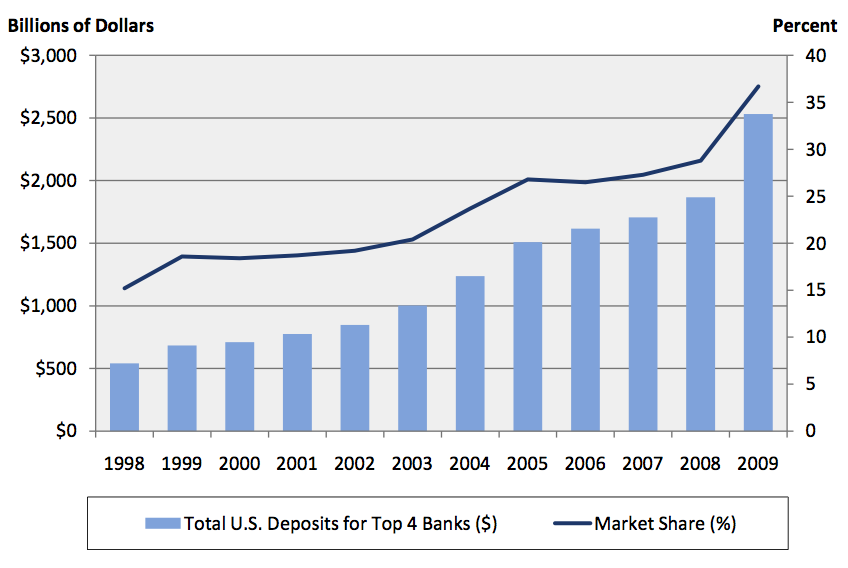
Back-asswards: Biggifying Too Big to Fail

What do we do in response to a financial crisis due in no small part to the systemic risk posed by institutions that by their very size prove essential to a functioning financial system? Gorge them on taxpayer funds so they get even bigger, while smaller banks without the benefit of implicit government guarantee are allowed to fail (as all insolvent businesses should):


From TARP Oversight Report via TBP.

Tuesday, June 9, 2009

TARP ROI? Also: PPIP, we hardly knew ye.

A tasty morsel from Planet Money:

Treasury Department just sent out this statement saying that 10 of the largest financial institutions have been cleared to repay their bailout money, totaling as much as $68 billion.
Mixed news of course - we'll have to wait until all is said and done to properly judge TARP, and this ignores any systemic or solvency problems that may still exist, but if the taxpayer comes close to breaking even on this it'll be a major win.


On a related note, remember all the hullabaloo about Geithner's infamous PPIP? Yeah, that whole thing never got off the ground. (Which might actually be a good thing.)

Thursday, April 30, 2009

Ca$h Rules Everything Around Me, C.R.E.A.M. Get Those Election Funds, Dolla Dolla Bill, Y'all

(With apologies to the Wu-Tang Clan.)

Not news so much as an acute kick in the cubes of Good Government:

Nobody even tries to hide this any longer. The only way they could make it more blatant is if they hung a huge Goldman Sachs logo on the Capitol dome and then branded it onto the foreheads of leading members of Congress and executive branch officials.
Quoted in the article, this doozy from Matt Taibbi:
That’s why even people like [Glenn] Beck’s audience, who I’d wager are mostly lower-income people, can’t imagine themselves protesting against the Wall Street barons who in actuality are the ones who fucked them over. . . .

Actual rich people can’t ever be the target. It’s a classic peasant mentality: going into fits of groveling and bowing whenever the master’s carriage rides by, then fuming against the Turks in Crimea or the Jews in the Pale or whoever after spending fifteen hard hours in the fields. You know you’re a peasant when you worship the very people who are right now, this minute, conning you and taking your shit. Whatever the master does, you’re on board. When you get frisky, he sticks a big cross in the middle of your village, and you spend the rest of your life praying to it with big googly eyes. Or he puts out newspapers full of innuendo about this or that faraway group and you immediately salute and rush off to join the hate squad. A good peasant is loyal, simpleminded, and full of misdirected anger. And that’s what we’ve got now, a lot of misdirected anger searching around for a non-target to mis-punish . . . can’t be mad at AIG, can’t be mad at Citi or Goldman Sachs. The real villains have to be the anti-AIG protesters! After all, those people earned those bonuses! If ever there was a textbook case of peasant thinking, it’s struggling middle-class Americans burned up in defense of taxpayer-funded bonuses to millionaires. It’s really weird stuff.

And don't forget:
One might think it would be a big news story for the second most-powerful member of the U.S. Senate to baldly state that the Congress is "owned" by the bankers who spawned the financial crisis and continue to dictate the government's actions. But it won't be.
Indeed. Ah, America!

Greenwald over at Salon. Good stuff, if you don't mind vomiting after reading.

Tuesday, March 24, 2009

The Geithner Put: Will It Work?

Interesting debate between four economists over at the Times concerning the latest revision of the TARP from Treasury.

From what I understand - and don't quote me on this - Geithner's program provides non-recourse low-cost loans to private investors. Basically the gov't is subsidizing about 93% of the cost of buying up at least $500B in toxic assets. This gives investors essentially zero downside with the taxpayer* FDIC on the hook for major cabbage if the assets turn out to be worthless in actuality, not just artificially depressed (as the Geithner camp is hoping is the case).

The debate ranges from "this plan sucks" (Krugman) to "better than nothing" (DeLong). From what I've read it seems that the plan will help, but the real question is whether it is just delaying an inevitable nationalization.

*Update: My mistake. The taxpayer isn't on the hook because the FDIC (funded by bank fees, not tax dollars) guarantees the loans to investors to purchase suspect loans from banks, although the taxpayer is on the hook for the second part of the program, which targets purchase of mortgage-backed securities (the typical so-called toxic assets). Check this post for clarification. But the gov't is nevertheless giving investors a huge incentive here assuming auction prices are acceptable to institutions holding these crappy assets.

Wednesday, March 11, 2009

Shackled By Debt: Slaves to the Banks

Remember this? A year ago to the day I posted about this video, Money As Debt:


It's interesting to watch this again given the current crisis. Ignoring the paranoia/conspiracy overtones for now, we are seeing the main theme of the video act itself out to a large degree. We're seeing the fallout from the collapse of the huge credit bubble that grew in the last decade. We're seeing how enormous money center banks and similar financial entities - Citi, Bank of America, AIG - are by their essential nature holding the U.S. Government - and thus the American taxpayer - hostage. These banks that are "too big to fail," necessarily protected by a doctrine implicit in that belief, having failed to function effectively in a poorly-regulated free market, are now dependent on support from the very people that are suffering due to the negligence, poor risk management, and gross incompetence of these banks.

Moving forward we cannot allow "too big to fail" to exist because it carries with it an inherent risk to the health of the financial system.

Sunday, March 8, 2009

Banking Crisis Explained

And of course, if [the U.S. government] were planning to take over the banking system, they wouldn't announce it beforehand. They'd probably say exactly what they're saying right now, at least until they got everything set up, until they hired enough people, put all their plans in order...and then one Friday evening, they'd make an announcement...and nationalize the banks over the weekend.
Last week's episode, "Bad Bank," of This American Life, has a very basic yet excellent primer on what banks are, how they function, and what is at the core of the current banking crisis - toxic assets, balance sheets, mark-to-market, write-downs, and the like. Alex Blumberg and Adam Davidson use a simple scenario to illustrate how banks are capitalized and what can lead to insolvency. The basics are simple but can be difficult to understand while trying to ignore things like mortgage-backed securities, CDOs, CDSs, ARMs, TARP, TALF, FDIC and other esoteric financial instruments and inscrutable acronyms.


There's also a great discussion with Simon Johnson, former chief of the International Monetary Fund (IMF), Professor at MIT's Sloan School of Management, and - most impressively - fellow blogger, about the pros and cons of nationalization.


Columbia prof David Beim discusses this graph, which is frightening. Currently consumers owe 100% of GDP - some $13 trillion. The only other time the Household Debt to GDP ratio has been 1:1? 1929:
"The problem is us. The problem is not the banks, greedy though they may be, overpaid though they may be. The problem is us... We've been living very high on the hog. Our living standard has been rising dramatically in the last 25 years. And we have been borrowing much of the money to make that prosperity happen."
It's not as simple as forcing the banks to lend, unfortunately.


In the second segment they talk to a couple entrepreneurs of Mortgage Strategies, who are buying mortgages from banks at a discount and negotiating with homeowners to either refinance their mortgage at a much lower monthly payment (but still very profitable for MS because they bought, say, a $400K mortgage for $200K to be refinanced at $300K), or stay in the home and rent it from MS.

Of course these are just a couple guys, and although they are smart and able to bring in investors, they are only able to handle a tiny percentage of the total mortgage debt out there. Also these are simplest of these assets - just a mortgage between a bank and a homeowner. They aren't exposing themselves to the intricate mortgage-backed securities. Still, it's a free-market solution that shows that even right now there is money to be made and people are taking risks to make it. That's some good old-fasioned American know-how (plus Columbia MBAs and millions in investor capital).

The TALF is actually a gov't sponsored version of this for things like small biz loans, student loans, and car loans, aimed to give private equity generous lending terms with Treasury backing any potential loss due to consumer default. Good idea but possibly implemented too late - such securitized lending still requires consumer demand, which has all but vanished right now.


It's a great show. Take a listen when you get a spare hour. Very helpful for laymen like myself understand WTF is going on right now.