Showing posts with label History. Show all posts

Tuesday, November 10, 2009

Wreck of the Edmund Fitzgerald 34th anniversary

34 years ago today, on November 10, 1975, the SS Edmund Fitzgerald - aka "Mighty Fritz," - foundered and sank during a storm on Lake Superior. Launched on June 8, 1958, the Edmund Fitzgerald was . . . more

Thursday, June 4, 2009

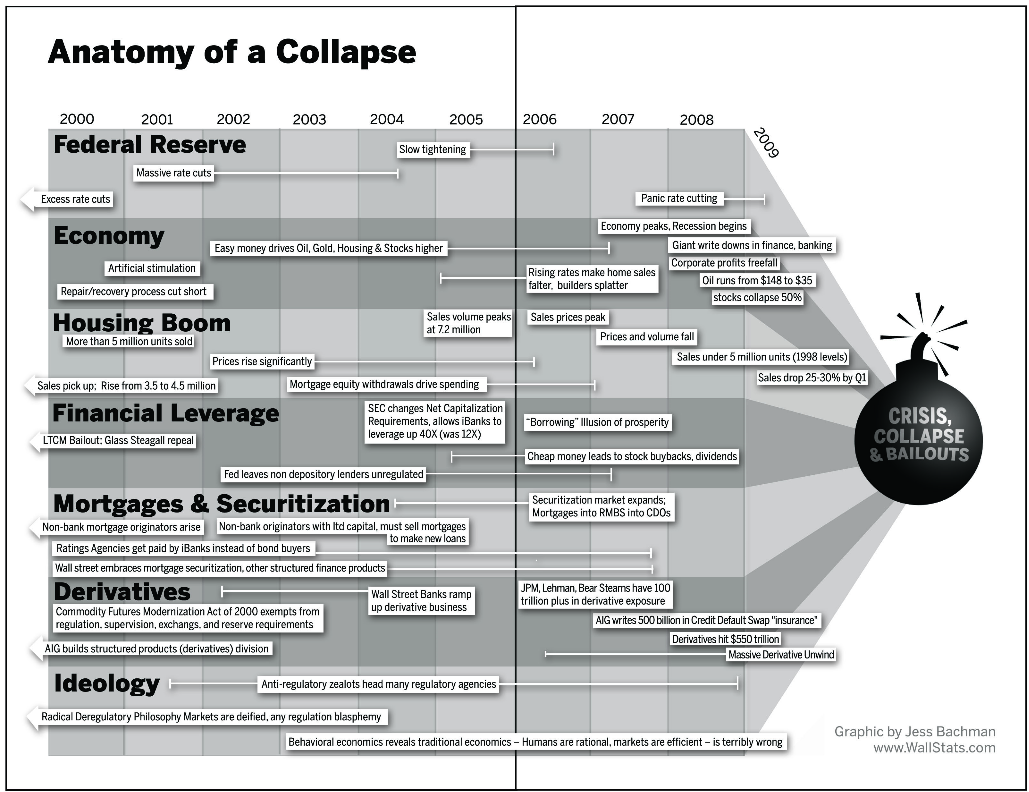
Anatomy of a Collapse

An excellent infographic detailing the causes of the Great Financial Meltdown of 2008-? From The Big Picture, lifted from Ritholz's new book, Bailout Nation.


(Click to enlarge.)

I would've preferred they had used an image of a gigantic shit sandwich instead of a bomb at the end.

Thursday, April 9, 2009

One from "The More Things Change..." File:

A cartoon from the Chicago Tribune, 1934. The refrain sounds so familiar, doesn't it? (Click to enlarge.)


Via the increasingly indispensable Big Picture.

Sunday, March 8, 2009

Cartographic Violence

A nod to ("Hot" )foot for bringing this recent Strange Maps post to my attention. It's a funny cartoon about WW II featuring the countries as characters. Check it out. Because if you're wasting time reading this blog, you might as well laugh, right?

Tuesday, February 10, 2009

Make Work?

A very interesting piece by Brad Hicks on the Great Depression, public works projects, and how it all relates to our current situation.

Via the weird, wily Wax.

Wednesday, February 4, 2009

Obama's Golden Trumpet

Jonathan Raban has an excellent analysis of the President's inaugural address.

Hat tip to BRhé for the link.

Monday, November 17, 2008

The Bixby Letter

Interesting article about a possible authentic copy of Abraham Lincoln's famed "Bixby Letter" buried in the archives of the Dallas Historical Society.

Here's the text of the Bixby Letter:

Executive Mansion, Washington, Nov 21, 1864
To Mrs. Bixby, Boston, Mass.

Dear Madam,

I have been shown in the files of the War Department a statement of the Adjutant-General of Massachusetts, that you are the mother of five (5) sons who have died gloriously on the field of battle.

I feel how weak and fruitless must be any word of mine which should attempt to beguile you from the grief of a loss so overwhelming. But I cannot refrain from tendering you the consolation that may be found in the thanks of the republic they died to save.

I pray that our Heavenly Father may assuage the anguish of your bereavement, and leave you only the cherished memory of the loved and lost, and the solemn pride that must be yours to have laid so costly a sacrifice upon the altar of freedom.

Yours, very sincerely and respectfully,
A Lincoln

Five sons.

Thursday, October 30, 2008

"God has been good to me."

Indeed He has, Amanda. A pretty amazing story. Lincoln would've been proud.

Props to Mean Rachel for the link.

Thursday, September 25, 2008

Pay Attention

Lessig on Palin:


Don't eff this up, America.

Thursday, September 11, 2008

The Founding Fathers

This is just one example of the marked difference between these two campaigns.

Current politics on Boston 1775 now!

Thursday, August 28, 2008

Inspired

Congratulations to Senator Barack Obama.

Friday, May 2, 2008

Art from the Great War

Very cool recent post over at Strange Maps.

Monday, April 28, 2008

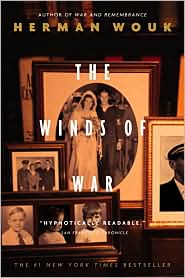
The Winds of War


Peace, if it ever exists, will not be based on the fear of war, but on the love of peace. It will not be the abstaining from an act, but the coming of a state of mind. In this sense the most insignificant writer can serve peace, where the most powerful tribunals can do nothing.

-Julien Benda, a French Jew

So reads the quotation in the foreword to The Winds of War, by Herman Wouk. This book is without a doubt the best $0.25 I have ever spent. War is an epic novel of World War II. It follows the Henry family from the summer of 1939 up until December of 1941, just after the Japanese attack on Pearl Harbor. The Henrys are the archetypical Navy family. Victor "Pug" Henry is a captain, getting up there in age, watching his Annapolis classmates get promotions and prestigious commands while he remains stuck on land. He yearns for command of a "battlewagon" - one of the several battleships which symbolize the United States' naval power. His wife, Rhoda, feels the same way, and though their marriage is strong, it grows stale. She envies the wives of Pug's more successful peers. The Henrys' eldest son, Warren, is a cocksure young lieutenant who becomes a naval aviator, flying the Douglass SBD Dauntless. Byron, although he was Navy ROTC, is a nominal academic, having pursued a somewhat aimless career in art history. He is now off in Italy, working for a famous Jewish author and his niece. Eventually he becomes a submariner as the likelihood of the US entering the war grows greater. Madeline has just graduated from college and is on her own in New York City, working in the glamorous radio business - much to the chagrin of conservative, religious Pug.

The book is about the lead-up to America's entrance into the war, and describes in detail the mentality in the US before Pearl Harbor. Many characters in the book - Americans and Britons among others - respect Hitler as a leader for having reinvigorated Germany after the embarrassment of Versailles. Although many agree that some of Hitler's anti-Semitic policies are "excessive," there is little in the way of sympathy for European Jews from the average American. Wouk does a good job of capturing the insidious anti-Semitism of the period - both the subtle, casual anti-Semitism manifested in offhand comments and the "us and them" mentality of people like the otherwise virtuous Henry; and the blatant, pervasive racism that gave Hitler and his cronies the moral authority to perpetrate unprecedented evil against the European Jewry, culminating in the Holocaust.

The Henry family is buffeted by the winds of war: Hitler's invasion of Poland and the Sitzkrieg; the invasions of France and Norway; the Battle of Britain; the invasion of the Soviet Union; and the attack on Pearl Harbor. In the midst of all this the Henry sons fall in love and Pug and Rhoda's marriage is put to the test as Pug is off in numerous countries as special naval attaché. Although this is still a desk job, it is important, and provides him not only with the ear of President Roosevelt, but also gives him the opportunity to meet a cast of the major characters of the period - Hitler, Ribbentrop, Goering, Mussolini, Churchill, and Stalin. While the scenario perhaps stretches credibility a bit, it provides the reader with an excellent opportunity to "meet" these imposing historical personages and makes for fascinating reading.

There's so much going on that it's impossible to touch upon everything, but the reader sees most of the major events of the initial years of war either directly through the novel's main characters (Byron finds himself caught in Warsaw during the blitzkrieg, for instance) or indirectly as news of events in Europe reach America. Although it is widely believed that America will not fight a war to "save the Jews," the threat of Japan in the Pacific is growing and war with the Empire of the rising Sun is seen as inevitable.

The Winds of War is an excellent novel. One of the best I have read. Its scope is impressive and its characters are compelling. As a history buff, I found its attention to detail and historical accuracy amazing. As major events occur in the novel, Wouk provides excerpts from World Empire Lost, a historical work by the fictional German General Armin von Roon, translated into English after the war by Victor Henry. These excerpts provide the reader with a historical exposition of sorts to help the reader understand the big picture of the war as it develops, and also show the German point of view. Very interesting to read.

Despite the fact that it's a 1,000-plus page novel, it feels like an introduction. It was surprisingly readable for a novel of its size and depth, and it was probably the fastest 1,000 pages I've ever read. It ends just as Congress votes for a declaration of war on the Empire of Japan, with the so-called Arsenal of Democracy gearing up to defeat fascism on both sides of the globe. I am very much looking forward to reading the sequel, War and Remembrance. I recommend this highly.

Monday, April 14, 2008

Simmons Is Stoopid?

Heh. Chris over at A Large Regular pokes fun at the Sports Guy's knowledge of history. Rather nitpicky, methinks, but amusing nonetheless (and Chris make a good point, as always).

Friday, March 28, 2008

Did the Blitz Save Britain?

An interesting article about the German bombing of London during World War II over at TheAtlantic.com. In part it's a critique of Peter Stansky's book, The First Day of the Blitz. A couple good points in there about how the start of intense bombing raids on London came at a decisive point during the Battle of Britain, and marked a shift in German strategy than may have enabled the RAF to recover enough to finally repel the Luftwaffe. Good stuff by way of Arts & Letters Daily, a nice collection of links to articles, book reviews, essays, and opinion pieces (hat tip to Dad for turning me onto this).

Thursday, March 20, 2008

History: All About the Facts?

An interesting article from The New Yorker about fiction vs. history.

Hat tip to Dad for the link.

Friday, February 15, 2008

The Disappearance of European Violence

Geoffrey Wheatcroft discusses James Sheehan's Where Have All the Soldiers Gone, a book about Europe's demilitarization over the last 60 years. Interesting commentary.

Sunday, January 13, 2008

Conflict on the High Seas Is Historically a Casus Belli for U.S.

An interesting article, spurred by the recent incident in the Straits of Hormuz, talking about how the United States has often gone to war as a direct result of threats to or attacks on our sea power, whether it be military or commercial vessels.

These run the gamut from the (probably accidental) explosion of the USS Maine to the disastrous assault on our fleet with Japan's attack on Pearl Harbor in December of 1941. The recent event in the Straits of Hormuz did not escalate due to the discipline of our naval officers - but it could have sparked a war with Iran.

Mead makes an interesting point, and while the Hormuz incident differs both in kind and scope than some of our past travails on the high seas, it nevertheless represents a direct threat to U.S. sea power. And that's something that we have defended vigorously in our history as a nation.

Link via Neptunus Lex, who you should put on your blogroll for great commentary on the military and foreign affairs with a naval bent.

Wednesday, January 9, 2008

A Soldier's Declaration

The following letter was written by a soldier in combat to the powers that be back home:

I am making this statement as an act of wilful defiance of military authority because I believe that the war is being deliberately prolonged by those who have the power to end it. I am a soldier, convinced that I am acting on behalf of soldiers. I believe that the war upon which I entered as a war of defence and liberation has now become a war of agression and conquest. I believe that the purposes for which I and my fellow soldiers entered upon this war should have been so clearly stated as to have made it impossible to change them and that had this been done the objects which actuated us would now be attainable by negotiation.

I have seen and endured the sufferings of the troops and I can no longer be a party to prolonging these sufferings for ends which I believe to be evil and unjust. I am not protesting against the conduct of the war, but against the political errors and insincerities for which the fighting men are being sacrificed.

On behalf of those who are suffering now, I make this protest against the deception which is being practised upon them; also I believe it may help to destroy the callous complacency with which the majority of those at home regard the continuance of agonies which they do not share and which they have not have enough imagination to realise.

Sound at all familiar?

It was written by Lt. Siegfried Sassoon, 3rd Battaltion, Royal Welsh Fusiliers, in July of 1917. It was a statement to his commanding officer declining his return to duty. It was read aloud in the House of Commons and printed in the London Times the following day.

I'm just posting it here without any comment on my particular feelings toward the ongoing war in Iraq because as I read it I thought, "Wow, this could very well have been written today." (Save the last paragraph; I hardly think we are "complacent" back home.) I guess my point is, in part, that history repeats itself; that the full effect of current events is not realized until years, often decades hence; and that no matter what the era, conflict, or reasons for it, violence as national policy is an unfortunate (but sometimes necessary) evil.

Source: Wikipedia.org

Wednesday, December 5, 2007

I'll Drink to That!

On this day in 1933, the 21st Amendment to the Constitution was ratified. This repealed the 18th Amendment, ending Prohibition. Those were dark days indeed for the nation.

Cheers!