Showing posts with label Authors. Show all posts

Friday, March 27, 2009

No More Snow; What a Relief


I recently finished reading Snow, by Orhan Pamuk. Pamuk's an accomplished Turkish author, and Snow is one of several novels of his. Pamuk won the Nobel Prize in Literature for Snow in 2006; there must've been a weak field that year because Snow is incredibly disappointing. And unfortunately I don't think one can blame this on translation.

I really wanted to enjoy Snow. I had been looking forward to reading it for a while - it was a gift from my Dad a couple years back and it had been gathering dust on my shelf for far too long before I finally took it up. Because it was a personal gift, because it had the gold Nobel Prize sticker on the front, I had high expectations. But Pamuk's novel moves at a glacial pace, features an unconvincing central relationship, and has few bright spots to recommend it. The quality of the writing itself is very high; there are a few wonderful passages in there. But as a novel it falls far short of being enjoyable.

Snow is about a Turkish poet named Ka, who hails from the small city of Kars. He has spent the last few years living in exile in Germany but there was been a wave of suicides among teenaged girls in Kars. Forbidden to wear the head scarf according to Islamic tradition by the secular Turkish government, several of these fundamentalist religious girls have killed themselves. Ostensibly Ka returns to Kars in the guise of a reporter for a German paper to uncover the truth about these suicides, but he is also drawn to the city by the news that his previous love Ipek has left her husband.

There's a lot that's intriguing about the idea of Snow: the rash of suicides; the struggle between religion and secularism; violence as revolution sparks in Kars; a burgeoning relationship between two childhood friends. But it never becomes compelling. Finishing this novel was an absolute chore for me. It took me a long time to get into it (which I never really did) and took me a while to finally finish it. Very disappointing.

So don't read Snow. (Sorry, Laura!) I can't help but think that Pamuk's other work might be decent - he certainly has skill as a writer - but I don't think I can bring myself to try it anytime soon.

In addition, I recently discovered that my Mom couldn't finish Snow and panned it. And she's not usually so critical of novels, so...there it is.

Sorry Dad - it's the thought that counts!

Sunday, March 1, 2009

The Triumph of the Readers

Ann Patchett had a nice piece in the WSJ a while back about numbers released by the NEA showing that the number of people reading fiction is on the rise. Especially surprising, perhaps, is the increase in the 18-to-24-year-old demographic.

There were a couple of passages that struck me, including this on reading bad books:

I am a firm believer in the fact that it isn't so much what you read, it's that you read. Reading fiction not only develops our imagination and creativity, it gives us the skills to be alone. It gives us the ability to feel empathy for people we've never met, living lives we couldn't possibly experience for ourselves, because the book puts us inside the character's skin....Even if you're stepping into "Valley of the Dolls," it's better than nothing. I'm all for reading bad books because I consider them to be a gateway drug. People who read bad books now may or may not read better books in the future. People who read nothing now will read nothing in the future.
I remember when I was younger and met kids who didn't read at all. It baffled me. I meet people today who don't read at all. And it still baffles me. They are missing out on so much.

And towards her closing:
If someone gave you a device with which you could see entire worlds just by holding it in front of your eyes, worlds of such beauty and complexity that they took your breath away, worlds of suffering and redemption, love and suspense and enlightenment, all of them there for the taking, wouldn't you want to show this device to everyone you knew? Why are more people reading? Because they are either discovering or remembering just how good it can be. I've got a book for you, my friend, all you've got to do is open it up.
Tonight I plan on seeing the world of Kars, Turkey. My viewing device is Snow, by Orhan Pamuk. I'll let you know how it turns out.

Saturday, November 8, 2008

The Grass Is Always Greener: A Review of Prague


Prague is the premiere novel of Arthur Phillips, a young and talented author. Prague received a good deal of critical acclaim when it was published in 2002, and it is deserved for the most part. I read Phillips' sophomore novel, The Egyptologist, last year and thoroughly enjoyed it. Prague actually takes place in Budapest in 1990 shortly after Hungary became a democracy following the Communist era, and it follows the lives of several American expats: Charles Gábor, born in Hungary but raised in the US, returning to his homeland in the hopes of business success; Mark Payton, listless grad student, working on his interminable, impractical research; Emily Oliver, Nebraskan goody two-shoes who works at the US embassy; Scott Price, caustic teacher of English who makes good (if morally questionable) use of the Hungarian girls in his class; John Price, Scott's brother, aimlessly following his brother to Budapest in the hopes of adventure. The novel is mainly told through the eyes of John, and as such he is a protagonist of sorts. The novel has autobiographical elements, although Phillips maintains these are limited (he lived in Budapest for two years in the early nineties). The novel is "modern" (or post-modern?) in that it lacks any real plot. It's filled with the details of quotidian twenty-something existence - sex, drugs, romance, drama, music, parties, depression - flitting between melodrama and ennui as such topics tend to do. Phillips is a talented writer. He has a flair for wordplay, irony, and can turn an excellent phrase. It's certainly a highly literary novel. The novel felt a bit long - its last 50 or so page anticlimax was a bit tough to slog through. But on the whole it was a good read.

Reading the novel was a special joy for me, having spent some time in Budapest this summer, and reading about several familiar places - the Chain Bridge, Vörösmarty Square, Café Girbeaud - added another layer of meaning to the book. According to an interview with Phillips at the end of the book, the title is inspired by an emotional disorder - the idea that "if only I were somewhere else, doing something different, with a different person, things would be better." It's that "grass is always greener" feeling. At the time, Prague was the hot city to visit for young Americans - Phillips' point is that those in Prague probably felt envious in the same way about their counterparts in Budapest. A good novel from a talented up-and-coming author.

Monday, September 29, 2008

Literary Lunacy


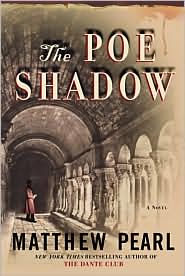
The Poe Shadow, by Matthew Pearl. Very disappointing. Pearl's first novel, The Dante Club, was excellent - a mystery based in historical Boston. Well-written with a compelling, chilling plotline. I was very much looking forward to Pearl's sophomore effort, which makes the lackluster Shadow all the more disappointing. If one's sole desire upon picking up a book is to finish it so as to start something more enjoyable or interesting, that does not speak very highly of the novel. Unfortunately, The Poe Shadow was just such a one of these books for me. (Of which I have encountered too many as of late. I must vet my reading list more carefully.)

The Poe Shadow takes place in Baltimore, Maryland, in 1841. The protagonist is a lawyer who just happens to pass by the poorly-attended funeral of Edgar Allan Poe, of whom he is a fan. "Fan" actually doesn't do Quentin Clark's enthusiasm for Poe's work justice, as he is obsessed well beyond the brink of sanity. After Poe's death, the media was not kind, speaking of his penury, his alcoholism, his dying alone (a mere four people attended his funeral), and generally not exalting Poe's literary gift to the world in the manner in which Clark feels that Poe deserves. Clark sets out to clear Poe's sullied reputation and uncover the mystery surrounding his death. Knowing that he cannot do this on his own, Clark solicits help from the very pages of Poe's work - C. Auguste Dupin, the star of Poe's detective stories, including "The Murders in the Rue Morgue" and "The Purloined Letter." Dupin was evidently based on someone whom Poe knew in real life, so Clark crosses the Atlantic to Paris to locate the "real" Dupin, and meets several characters who claim to be the inspiration for Dupin for their own motives.

The frustrating thing about the novel is that the mystery at its core isn't a compelling one. True, there were some murky details surrounding Poe's death, but nothing particularly interesting or relevant (such as the question of foul play). The novel is simply a madman's attempt to reconcile reality with his idealized version of Poe - or at least comes off like that.

It's an interesting novel as a period piece, and it does get a bit better toward the end, when Clark becomes exposed to genuine danger. It's also interesting that the novel contains previously unpublished theories about Poe's death based on Pearl's own research. This use of historical research to bring new information to light in the form of a novel is impressive, but unfortunately it can't save it. On the whole it's a frustrating, disappointing experience. Keep your Pearl reading to The Dante Club.

Sunday, September 14, 2008

RIP DFW

Suicide of another tortured writer. A shame. Why does this bother me so even though I haven't read David Foster Wallace at all?

I feel obligated to move Infinite Jest a bit higher in my reading list.

Wednesday, August 6, 2008

Heartbreaking, indeed. Genius? Not so much.


A Heartbreaking Work of Staggering Genius, by Dave Eggers. What a disappointment. I had heard a lot of positive things about this autobiographical book over the last few years, prompting me to pick it up at my favorite used book sale. The introduction was quite promising, as Eggers provides the reader with instructions on how to read the book which I found to be pretty amusing. However, the bulk of the book is too long, at times variously maudlin and boring, occasionally funny, but on the whole a trial to get through. Eggers appears to be both pretentious and self-deprecating, but it's hard to determine when, and the effort isn't worth the dubious rewards.

Eggers' parents both died of cancer when he was in his early twenties. They left him, an older sister and brother and his younger brother Christopher (Toph). The care and guardianship of Toph fell to Dave, and much of the book is about Eggers' stint in loco parentis for Toph. While it's a sad scenario, I found that I had to force myself to feel sympathy for the Eggers children. This account didn't do the situation justice. The narrative felt uneven, as if at times Eggers alternately doesn't care and then panders for the reader's sympathy.

The book pulls on the heartstrings a bit, as it cannot help but do - a young single man raising his younger brother largely on his own - but these are rare moments. The reader sees the two having fun, dealing with their parents' passing, but then Eggers mixes into this his struggles with publishing Might magazine - a kooky hipster rag - various twentysomething antics of the guys 'n' gals variety, a veritable discourse about his love/hate affair with MTV's Real World (which seemed alarmingly dated to me), and a bunch of other crap. It's a narrative with an unpleasant syncopation; a discordant arrangement.

This is a book which caused me to roll my eyes every time I took it up. I couldn't wait to finish it simply so I could start reading something else. One word to sum up this disaster? Annoying. I would avoid this one.

Eggers also widely employs a writing pet peeve of mine - pervasive profanity throughout. Now I'm no prude: profanity has a natural and reasonable place in dialogue, both actual and written, and is even effective used sparingly otherwise (its rarity emphasizing its power as verbiage) but I find its persistent use in prose outside of dialogue to be lazy, cheap, uninteresting and uninspiring.

But what the fuck do I know?

Tuesday, May 6, 2008

Posthumous Nabokov Novel

It looks like Nabokov's unpublished manuscript of The Original of Laura will finally be published by his son, Dmitri. It will be interesting to see how this manuscript, unfinished as it is, will be received.

I have to say that I can't help but reconsider my initial feeling on the matter. New work by a dead master writer? Seems like that cannot be anything but a good thing.

Wednesday, January 23, 2008

Nabokov's Final Wish

Vladimir Nabokov, author of Lolita and Pale Fire, made it clear before he died that he wished for his unpublished manuscript, The Original of Laura, to be destroyed. The manuscript now sits in a vault in a Swiss bank. Nabokov's wife failed to make a decision before she herself passed away and now that decision has fallen to Vladimir's son, Dmitri. Ben Rosenbaum has a nice article at Slate on the issue.

To me this isn't much of a decision at all. Dmitri should honor his father's wishes. Is it a tragedy that the world will never see the final genius of a revered author? Yes, but I think it would be far worse were the dying to have no final say in their legacy. Who knows why Nabokov wished the manuscript to be destroyed? His reasons are immaterial in my mind. It is his work - he gets the say in what happens to it, especially since he made it so explicitly clear. As an artist, as a dying man, and as a father, Nabokov's last desire should be fulfilled by his son. His legacy is one that will likely be eternal regardless of this final unfinished work. It's a shame but nevertheless a necessity that his final work should be committed to the flame.

(This reminds me that I need to actually read Nabokov, of whom I've read nothing. To have another lifetime to read everything I want to - if only.)